Support our educational content for free when you purchase through links on our site. Learn more
🌊 Brackish Water Aquariums: The Ultimate 2026 Guide to Estuarine Life

Ever wondered what it feels like to keep a tank that mimics the wild, shifting tides where rivers meet the sea? Welcome to the fascinating world of brackish water aquariums, a niche that bridges the gap between the serene freshwater hobby and the complex marine reef. Unlike the static environments of typical tanks, brackish setups offer a dynamic, living ecosystem teming with unique behaviors you won’t find anywhere else—from Archerfish spitting water to knock insects off the surface to Monos schooling like silver coins in a current.
Many beginners stumble into this hobby thinking it’s just “salty freshwater,” only to watch their fish suffer from improper salinity or roting plants. But don’t let that scare you off! In this comprehensive guide, we’ll walk you through the exact steps to master Specific Gravity, choose the right marine salt mix, and select species that will thrive rather than just survive. We’ll even reveal the secret to keeping lush plants in a salty tank and share our team’s personal stories of triumphs and “oops” moments that shaped our approach to estuarine aquascaping.
Ready to turn your tank into a symphony of aquatic life? Let’s dive in.
Key Takeaways
- Master the Mix: Success hinges on maintaining the correct Specific Gravity (SG) using a refractometer, not just guessing with salt.
- Species Selection Matters: Choose fish based on their natural salinity needs, ranging from low brackish (Mollies) to high brackish (Monos), and never mix incompatible species.
- Plant Life is Limited: Forget lush freshwater carpets; opt for hardy survivors like Java Fern, Anubias, or true Mangroves that thrive in salty conditions.
- Patience is Critical: Aclimating fish to brackish conditions must be a slow, gradual process over weeks to prevent fatal osmotic shock.
- Maintenance Nuance: Remember that salt does not evaporate; always top off with fresh water and recalculate salt additions during water changes.
Table of Contents
- ⚡️ Quick Tips and Facts
- 🌊 From Fresh to Salty: The Fascinating History of Brackish Water Aquariums
- 🧪 Mastering the Mix: Understanding Specific Gravity and Salinity Levels
- 🐠 The Ultimate Guide to Brackish Water Fish: Species, Compatibility, and Behavior
- 🌿 Brackish Water Plants: What Thrives and What Fails in Salty Conditions
- 🏗️ Building the Perfect Brackish Habitat: Materials List and Tank Setup
- 🚰 The Art of Aclimation: Introducing New Fish to Your Brackish Tank
- 🧹 Water Chemistry and Maintenance: Keeping Your Brackish Tank Crystal Clear
- 🥗 Feding Frenzy: Dietary Needs of Brackish Water Inhabitants
- 🐚 The Live Rock and Substrate Debate: Sand, Gravel, and Decor Choices
- 🚫 Common Mistakes and Troubleshooting: Why Your Brackish Tank Might Be Struggling
- ✅ The Pros and Cons of Keeping a Brackish Water Aquarium
- 🏆 Our Top Recommendations: Best Brands for Brackish Water Supplies
- 📢 Subscribe for More Aquascaping Secrets
- 🛒 Featured Products We Love
- 🏁 Conclusion: Is a Brackish Tank Right for You?
- 🔗 Recommended Links
- ❓ Frequently Asked Questions (FAQ)
- 📚 Reference Links
⚡️ Quick Tips and Facts
Before we dive headfirst into the brackish abyss, let’s hit the pause button and drop some essential knowledge that will save you from the dreaded “new tank syndrome” (and a very expensive trip to the pet store).
- It’s Not Just “Salty Freshwater”: Brackish water is a unique ecosystem where freshwater rivers meet the ocean. It’s not a 50/50 mix; it’s a dynamic, fluctuating environment.
- The Golden Rule of Salt: Never use table salt or standard aquarium salt (sodium chloride only). You need marine salt mix containing magnesium, calcium, and trace elements.
- The “Molly” Myth: Did you know many fish sold as “freshwater” are actually brackish natives? Mollies, Figure 8 Puffers, and Archerfish often thrive better with a little salt.
- Specific Gravity is King: Forget pH for a second; your Specific Gravity (SG) is your most critical metric. Most beginner brackish tanks aim for 1.05 to 1.012, while advanced setups can go higher.
- Evaporation Trick: Salt does not evaporate. If you top off your tank, use fresh dechlorinated water, or you’ll accidentally turn your tank into a brine shrimp farm (and kill your fish).
- Plant Struggle: Most lush freshwater plants will rot in brackish water. You need brackish-tolerant species like Java Fern, Anubias (with caveats), or Mangroves.
Ready to turn your tank into a symphony of estuarine life? Let’s get the history books open.
🌊 From Fresh to Salty: The Fascinating History of Brackish Water Aquariums

You might think brackish water aquariums are a modern fad, but the story goes back much further than the first plastic fish tank. The concept of keeping fish from the “in-between” zones—estuaries, mangroves, and river mouths—has fascinated aquarists since the Victorian era, though it was often misunderstood.
For decades, the hobby was split into two camps: Freshwater (easy, cheap, plants galore) and Saltwater (expensive, technical, coral reefs). Brackish water was the awkward middle child, often dismissed as a “failed saltwater tank” or a “salty freshwater tank.”
“Unlike the corals in saltwater reef tanks, brackish species are used to fluctuating conditions because they live in estuaries where rivers and streams meet the ocean.” — Aquarium Co-op
This adaptability is the secret sauce. Early aquarists noticed that certain fish, like the Molly (Poecilia spp.), seemed to live longer and breed more readily when a pinch of salt was added. It wasn’t until the late 20th century, with the rise of specialized literature like Frank Schäfer’s Brackish-Water Fishes, that the community realized these weren’t just “hardy freshwater fish” but distinct species requiring specific salinity levels.
Today, we know that maintaining a stable brackish environment isn’t just about adding salt; it’s about replicating the mineral balance of an estuary. We’ve moved from guessing with hydrometers to precise refractometer readings, and from keeping only the hardiest gobies to successfully raising Archerfish and Monos.
But why do we bother? Why not just stick to freshwater? The answer lies in the behavioral richness of these fish. Have you ever seen a fish that spits water to knock insects off the surface? Or a crab that walks on land? That’s the brackish magic we’re chasing.
🧪 Mastering the Mix: Understanding Specific Gravity and Salinity Levels
If you take one thing away from this article, let it be this: Specific Gravity (SG) is the heartbeat of your brackish aquarium.
Salinity in brackish tanks is measured in Specific Gravity (the density of water compared to pure water) or Parts Per Million (PPM). While freshwater is 1.0 and full seawater is roughly 1.026, brackish water lives in that murky, beautiful middle ground.
The Target Ranges
Not all brackish fish are created equal. Some need a “light” brackish touch, while others demand a near-marine environment.
| SG Range | Salinity (approx.) | Suitable For | Difficulty |
|---|---|---|---|
| 1.05 – 1.08 | Low Brackish | Mollies, Guppies, Figure 8 Puffers (young) | Beginner |
| 1.010 – 1.015 | Mid Brackish | Bumblebee Gobies, Archerfish, Green Spotted Puffers (adults) | Intermediate |
| 1.018 – 1.02 | High Brackish | Monos, Scats, Colombian Shark Catfish | Advanced |
Crucial Insight: Many sources suggest a “one size fits all” approach, but that’s a recipe for disaster. A Green Spotted Puffer kept at 1.05 will eventually develop swim bladder issues and a shortened lifespan. Conversely, a Bumblebee Goby dropped straight into 1.020 will likely suffer osmotic shock.
Tools of the Trade: Hydrometer vs. Refractometer
You cannot guess your SG. You must measure it.
- Hydrometers: The floating glass stick. Cheap, but notoriously inaccurate due to temperature sensitivity and parallax errors.
- Refractometers: The gold standard. They use light refraction to measure salinity. They are more expensive but essential for long-term success.
Pro Tip: Always calibrate your refractometer with distilled water (which should read 1.0) before every use.
The “Salt Crep” Phenomenon
One of the most common complaints in brackish keeping is salt creep. As water evaporates, salt crystals form on the glass, lid, and equipment above the waterline. This isn’t just ugly; it can fall back into the tank, spiking your salinity.
- Solution: Wipe the glass daily or install a craft mesh over the lid holes to catch the crystals.
🐠 The Ultimate Guide to Brackish Water Fish: Species, Compatibility, and Behavior
This is where the magic happens. Choosing the right fish is like casting a play; you need actors who can work together, not a cast that will eat the lead.
The “Starter Pack” (Beginer Friendly)
These fish are hardy, forgiving, and perfect for learning the ropes of salinity management.
- Mollies (Poecilia spp.): The kings of brackish. They thrive in SG 1.05–1.010. Look for Yucatán Mollies or Sailfin Mollies for the best results.
- Figure 8 Puffer (Dichotomyctere ocellatus): Often sold as freshwater, these actually need brackish water to reach adulthood. They are curious, interactive, and can be fin-nippers.
- Bumblebee Goby (Brachygobius spp.): Tiny, striped, and adorable. They need a sandy substrate and plenty of hiding spots.
The “Intermediate” Challenge
Ready to step up? These fish require specific tank sizes and stricter salinity control.
- Green Spotted Puffer (Dichotomyctere nigroviridis): Warning: These grow to 6+ inches and are highly aggressive. They need a tank of at least 30 gallons (preferably 5+) and SG 1.010–1.015. They are not for community tanks with small fish!
- Archerfish (Toxotes spp.): Famous for shooting water jets to knock prey into the water. They need a tall tank (to allow for jumping) and a secure lid. They are schooling fish and need groups of 3+.
- Dragon Goby (Gobioides broussonetii): Also known as the Purple Spotted Goby. They are bottom dwellers that can breathe air. They need a sandy substrate and are generally peaceful but large.
The “Advanced” Tier
For the seasoned aquarist with a large tank and a deep wallet.
- Monos (Monodactylus spp.): Silver, disc-shaped fish that look like living coins. They grow large (up to 10 inches) and need high SG (1.018+) and massive tanks (75+ gallons).
- Scats (Scatophagus spp.): Similar to Monos but with a more aggressive streak. They are omnivores and will eat almost anything.
Compatibility Checklist
- ✅ Do: Keep schooling fish (Archerfish, Scats) in groups.
- ✅ Do: Match tank sizes to adult fish sizes, not juvenile sizes.
- ❌ Don’t: Mix aggressive puffers with slow-moving, long-finned fish.
- ❌ Don’t: Put small gobies with large catfish or puffers.
Curiosity Gap: You might be wondering, “Can I keep my freshwater Beta with a Figure 8 Puffer?” The answer is a resounding NO. But what about keeping a Molly with a Bumblebee Goby? That’s a tricky balance we’ll explore in the maintenance section.
🌿 Brackish Water Plants: What Thrives and What Fails in Salty Conditions
Let’s be honest: Brackish water is a plant killer. Most of the lush, carpeting plants you see in freshwater aquascapes will turn to mush within weeks of adding salt.
However, nature is resilient, and there are survivors!
The “Surefire” Survivors
- Java Fern (Microsorum pteropus): The MVP of brackish plants. It can tolerate low to mid brackish conditions (SG 1.05–1.012). Tip: Aclimate it slowly over 2–3 months.
- Anubias (Anubias spp.): Similar to Java Fern, these are tough. They prefer to be attached to rocks or driftwood rather than buried in the substrate.
- Hornwort (Ceratophyllum demersum): Can survive in very low salinity, but growth will be stunted.
- Mangrove Trees (Rhizophora spp.): The only true “brackish” plant. They grow out of the water! You must suspend the roots in the water and keep the leaves dry. They require a dedicated light and regular wiping of salt spray.
The “Avoid at All Costs” List
- Cryptocoryne: Will melt instantly.
- Valisneria: Will turn brown and rot.
- Amazon Sword: Not a fan of salt.
- Most Carpeting Plants: No luck here.
Aesthetic Alternatives
Since live plants are limited, focus on hardscape. Driftwood, rocks, and mangrove roots create a stunning estuarine look. You can also use artificial plants made of silk or plastic, which are impervious to salt.
Did you know? Some aquarists use root tabs (like Aquarium Co-op Easy Root Tabs) to provide nutrients to mangroves planted in deep substrate.
🏗️ Building the Perfect Brackish Habitat: Materials List and Tank Setup
Setting up a brackish tank is a bit more involved than a freshwater one. You need to get the chemistry right from day one.
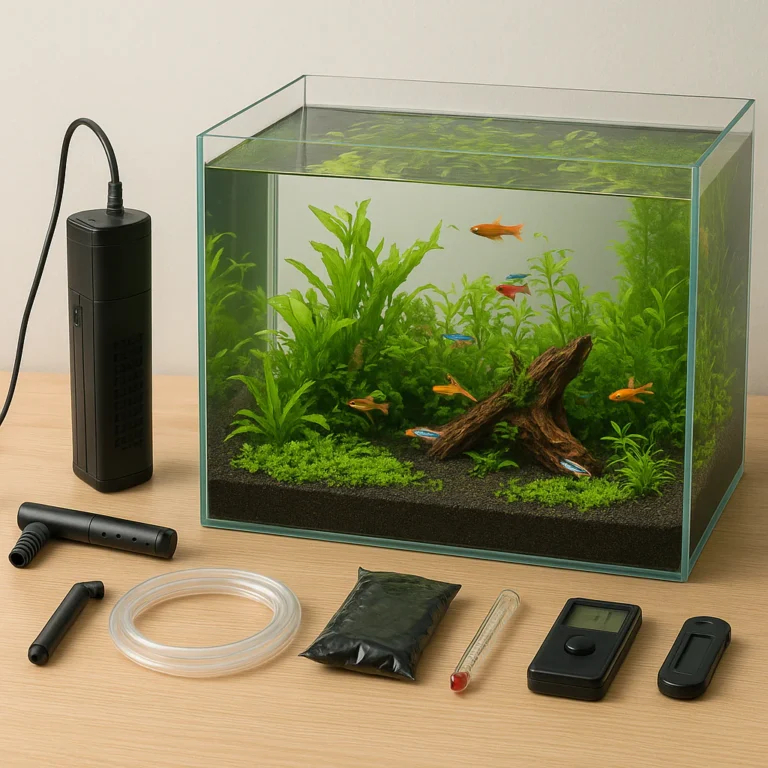
Essential Equipment Checklist
- Tank: Minimum 20 gallons for small species (Gobies, Figure 8 Puffers). 5+ gallons for Monos, Scats, or Archerfish.
- Filtration: Brackish fish produce a lot of waste. Use a canister filter or a robust hang-on-back (HOB) filter.
- Heater: Maintain 76–82°F (24–28°C).
- Lid: Mandatory. Many brackish fish are jumpers.
- Refractometer: For accurate SG readings.
- Marine Salt Mix: Instant Ocean or Red Sea are reliable brands.
- Substrate: Aragonite or Crushed Coral to buffer pH and hardness.
Step-by-Step Setup Guide
- Rinse and Prep: Rinse your substrate and decor thoroughly.
- Fill with Freshwater: Fill the tank with dechlorinated freshwater.
- Add Salt: Add marine salt mix. Do not add fish yet.
Formula: Start with 2 tablespoons of salt per gallon for low brackish. - Circulate: Run the filter and heater for 24–48 hours to dissolve the salt completely.
- Cycle the Tank: Establish the nitrogen cycle (amonia -> nitrite -> nitrate) just like a freshwater tank. This can take 4–6 weeks.
- Test SG: Use your refractometer to ensure you hit the target.
- Aclimate Fish: Slowly introduce your fish (see next section).
Pro Tip: If you have soft water (low pH), the aragonite substrate will naturally buffer the pH to 7.5–8.0, which is ideal for most brackish species.
🚰 The Art of Aclimation: Introducing New Fish to Your Brackish Tank
This is the most critical step. Most store-bought brackish fish are kept in freshwater by the retailer. Dropping them straight into a brackish tank is a death sentence.
The “Slow and Steady” Method
- Quarantine: Ideally, keep new fish in a separate quarantine tank for 2 weeks.
- Drip Aclimation: Use a drip line to slowly add tank water to the fish’s bag over 1–2 hours.
- The Salt Ramp: If the fish is in freshwater, you must gradually increase the salinity in the quarantine tank over 4 weeks.
- Week 1: Add a tiny pinch of salt.
- Week 2: Increase slightly.
- Week 3: Match the target SG.
- Week 4: Move to the main tank.
Why So Slow?
Fish have osmoregulatory systems that adjust to salinity. Changing too fast causes osmotic shock, leading to kidney failure and death.
Fun Fact: The gradual increase in salinity during aclimation can actually kill parasites like Ich, making brackish water a natural medicine!
🧹 Water Chemistry and Maintenance: Keeping Your Brackish Water Tank Crystal Clear
Maintenance in a brackish tank is a balancing act. You’re not just removing waste; you’re managing salt concentration.
The Evaporation Rule
Salt does not evaporate. Only water does.
- Action: When topping off, use fresh dechlorinated water only. Adding brackish water will raise your SG.
Water Changes
- Frequency: 25–50% weekly.
- Salt Calculation: You must replace the salt removed during the water change.
Example: If you do a 50% water change on a 20-gallon tank (targeting 2 Tbsp/gal), you remove 10 gallons of water and 20 Tbsp of salt. You must add 20 Tbsp of salt to the new 10 gallons of water before adding it to the tank. - Mixing: Always premix salt in a bucket with a powerhead or air stone. Never dump dry salt directly into the tank.
Testing Schedule
- SG: Check after every water change and weekly.
- Amonia/Nitrite: Weekly.
- pH/Hardness: Monthly.
🥗 Feding Frenzy: Dietary Needs of Brackish Water Inhabitants
Brackish fish are often omnivores or carnivores with specific dietary needs.
- Puffers: Need hard-shelled foods like snails and shrimp to grind down their beaks.
- Archerfish: Prefer live or frozen foods (brine shrimp, bloodworms). They can be trained to eat pellets, but it takes patience.
- Mollies: Omnivores. They love algae wafers, flake food, and blanched vegetables (zucchini, spinach).
- Gobies: Bottom feeders. Use sinking pellets and frozen mysis shrimp.
Tip: Avoid overfeeding. Brackish tanks are prone to high ammonia spikes if uneaten food rots.
🐚 The Live Rock and Substrate Debate: Sand, Gravel, and Decor Choices
Your substrate isn’t just for looks; it’s a chemical buffer.
- Sand: Essential for bottom dwellers like Dragon Gobies and Puffers. They sift through sand looking for food.
- Crushed Coral/Aragonite: The best choice for buffering pH and hardness. It mimics the natural estuarine environment.
- Live Rock: While common in saltwater, it’s less critical in brackish but can be used for biological filtration and aesthetics.
Decor:
- Driftwood: Adds tannins (which can lower pH slightly, so monitor closely).
- Rocks: Provide hiding spots.
- Mangrove Roots: The ultimate brackish aesthetic.
🚫 Common Mistakes and Troubleshooting: Why Your Brackish Tank Might Be Struggling
Even the best aquarists make mistakes. Here are the most common pitfalls:
- Using Table Salt: This lacks essential minerals and can harm fish.
- Ignoring SG Fluctuations: Not checking SG after water changes.
- Overcrowding: Brackish fish often need more space than freshwater fish.
- Wrong Plant Choice: Trying to grow freshwater plants that will rot.
- Rushing Aclimation: Adding fish too quickly to the new salinity.
Troubleshooting Table:
| Symptom | Possible Cause | Solution |
|---|---|---|
| Fish gasping at surface | Low Oxygen or High Amonia | Increase aeration, test water, perform water change. |
| Fish lethargic | Wrong SG | Check refractometer, adjust salt levels slowly. |
| White spots (Ich) | Parasite | Increase SG slowly (salt kills Ich), treat with medication. |
| Algae bloom | High nutrients | Reduce feeding, increase water changes, check light. |
✅ The Pros and Cons of Keeping a Brackish Water Aquarium
Let’s weigh the scales. Is a brackish tank right for you?
Pros
- Unique Species: Keep fish you can’t find in freshwater (Monos, Scats, Archerfish).
- Health Benefits: Brackish water can prevent diseases like Ich and improve the health of livebearers.
- Breding Opportunities: Some species (Amano shrimp, Nerite snails) require brackish water to reproduce.
- Fascinating Behavior: Watch fish spit water, walk on land, or school in silver clouds.
Cons
- Limited Plant Life: No lush aquascapes.
- Maintenance Complexity: Requires precise SG monitoring and salt mixing.
- Salt Crep: Constant cleaning of salt residue.
- Availability: Some species are hard to find and expensive.
🏆 Our Top Recommendations: Best Brands for Brackish Water Supplies
Based on our team’s experience, here are the brands we trust for brackish setups.
Salt Mixes
- Instant Ocean Reef Crystals: The industry standard. Reliable mineral balance.
- Red Sea Reef Salt: Excellent for high-end setups, though pricier.
Substrate
- CaribSea Super Naturals Arag-Alive: Great for buffering and aesthetics.
- Aquarium Co-op Crushed Coral: Affordable and effective for pH buffering.
Equipment
- Refractometer: Atago or Milwaukee (avoid the cheap plastic ones).
- Filters: Fluval or Eheim canister filters for heavy bioloads.
👉 CHECK PRICE on:
- Instant Ocean Reef Crystals: Amazon | Chewy | Brand Official
- CaribSea Arag-Alive: Amazon | Petco | Brand Official
- Atago Refractometer: Amazon | Bulk Reef Supply | Brand Official
📢 Subscribe for More Aquascaping Secrets
Want to master the art of the brackish tank? Subscribe to our newsletter for weekly tips, species spotlights, and exclusive guides on aquascaping with mangroves and salt-tolerant plants.
🛒 Featured Products We Love
Here are the specific products our team uses daily in our brackish setups:
- Refractometer: Atago Master-20M | Bulk Reef Supply
- Salt Mix: Instant Ocean Reef Crystals | Chewy
- Substrate: CaribSea Super Naturals Arag-Alive | Petco
- Root Tabs: Aquarium Co-op Easy Root Tabs | Brand Official
🏁 Conclusion: Is a Brackish Tank Right for You?
So, we’ve covered the history, the chemistry, the fish, and the plants. But the question remains: Is a brackish water aquarium right for you?
If you are looking for a low-maintenance, lush aquascape with easy-to-find fish, stick to freshwater. But if you are an aquarist who craves unique behavior, is willing to invest time in precise water chemistry, and wants to keep species that truly stand out (like the spitting Archerfish or the silver Monos), then a brackish tank is your symphony.
The journey from a “salty freshwater” mistake to a thriving estuarine ecosystem is challenging, but the reward is a tank that feels like a piece of the wild ocean in your living room. Remember: Patience is key, measure your SG, and aclimate slowly.
Ready to start your brackish adventure? Check out our Recommended Links for the best resources to get started!
🔗 Recommended Links
Essential Reading & Resources
- Books:
Brackish-Water Fishes by Frank Schäfer (Aqualog) – Amazon
Brackish-Water Fishes edited by Neale Monks (TFH) – Amazon - Online Resources:
- Aquariacentral Brackish Water Forum FAQ
- Estuarine Aquarium Keeping (Chesapeake Bay)
Where to Buy
- Instant Ocean: Official Website
- CaribSea: Official Website
- Aquarium Co-op: Official Website
❓ Frequently Asked Questions (FAQ)

What equipment is essential for a successful brackish water aquarium setup?
You need a refractometer (not a hydrometer) for accurate salinity readings, a marine salt mix (not table salt), a heater to maintain 76–82°F, a secure lid (many brackish fish jump), and a robust filtration system due to the high bioload of many brackish species.
Read more about “🌡️ The Ideal Water Temperature for a Tropical Fish Tank (2026)”
How do you gradually adjust fish to brackish water conditions?
Fish must be aclimated slowly over 4 weeks. Start with freshwater, then incrementally add small amounts of marine salt to the quarantine tank each week until the target Specific Gravity is reached. Never move a fish from freshwater directly to brackish water.
Read more about “Can I Mix Saltwater and Freshwater Fish in the Same Tank? 🐠🌊”
What are the common challenges of keeping a brackish water aquarium?
The main challenges are salt creep (salt residue on glass/lids), maintaining stable Specific Gravity during water changes, and the limited selection of plants that can survive in salty conditions.
Read more about “❄️ vs 🌡️: Cold vs. Tropical Fish Tanks: Which is Right for You? (2026)”
Can freshwater and saltwater fish coexist in a brackish aquarium?
Generally, no. Freshwater fish will suffer in high salinity, and true saltwater fish will struggle in low salinity. However, some hardy freshwater species (like Mollies) can adapt to low brackish conditions, and some marine species (like Blacktip Sharks) can tolerate lower salinity, but they are not ideal for beginners.
Read more about “🐠 Top 11 Fish Tank Reviews and Comparisons (2026)”
What plants are suitable for brackish water tanks?
Java Fern, Anubias, and Hornwort can survive in low to mid brackish conditions. Mangrove trees are the only true brackish plants, but they require their leaves to stay out of the water. Most other freshwater plants will rot.
Read more about “🏆 15+ Top Aquarium Equipment Reviews & Ratings (2026)”
How do you maintain water quality in a brackish water aquarium?
Perform weekly water changes (25–50%), ensuring you replace the salt removed. Always top off evaporated water with fresh dechlorinated water, never brackish water, to avoid spiking salinity.
What fish species thrive best in brackish water aquariums?
Beginer-friendly species include Mollies, Figure 8 Puffers, and Bumblebee Gobies. Intermediate species include Green Spotted Puffers and Archerfish. Advanced species include Monos and Scats.
Read more about “🏰 10 Best Themed Aquarium Decor Ideas for 2026”
What is the best salt mix for brackish water aquariums?
Use a marine or reef salt mix (e.g., Instant Ocean, Red Sea) that contains magnesium, calcium, and trace elements. Avoid standard aquarium salt (sodium chloride only).
Read more about “🐠 Freshwater vs. Saltwater: 5 Tank Types & Your Perfect Match (2026)”
How do you aclimate fish to brackish water?
Use the drip aclimation method over 1–2 hours, followed by a gradual salinity increase in a quarantine tank over 4 weeks to match the target Specific Gravity.
Read more about “🐠 7 Proven Steps to Introduce New Fish Without Stress or Disease (2026)”
What are the easiest brackish water fish for beginners?
Mollies are the easiest, followed by Figure 8 Puffers (with proper aclimation) and Bumblebee Gobies.
Read more about “🐟 Can You Breed Fish at Home? Top 10 Beginner Species (2026)”
Can you keep freshwater plants in a brackish tank?
Most freshwater plants will rot in brackish water. Only a few species like Java Fern and Anubias can survive in low salinity, and even then, growth is slower.
Read more about “🌊 Ultimate Aquarium Accessories & Equipment Guide (2026)”
What is the ideal specific gravity for a brackish aquarium?
It depends on the species. 1.05–1.08 for low brackish (Mollies), 1.010–1.015 for mid brackish (Puffers, Gobies), and 1.018–1.02 for high brackish (Monos, Scats).
Read more about “🌊 Master Aquarium Water Quality: 10 Secrets for Crystal Clear Tanks (2026)”
How often should you perform water changes in a brackish tank?
Perform 25–50% water changes weekly. Always recalculate and add the correct amount of salt to the new water.
Read more about “25 Best Freshwater Fish Species for Your Tank (2026) 🐠”
Do brackish water fish need special lighting?
No special lighting is required for the fish, but if you keep Mangroves, they need a dedicated light source for their leaves. Standard aquarium lighting is sufficient for most fish.
Read more about “15 Best Aquatic Plants for Fish Tanks to Transform Your Aquarium 🌿 (2026)”
📚 Reference Links