Support our educational content for free when you purchase through links on our site. Learn more
30 Tropical Fish Species for Aquariums 🐠 (2026)

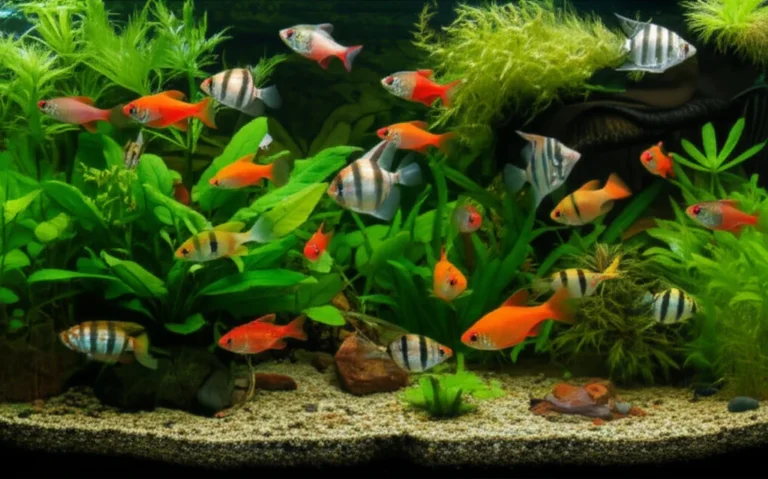
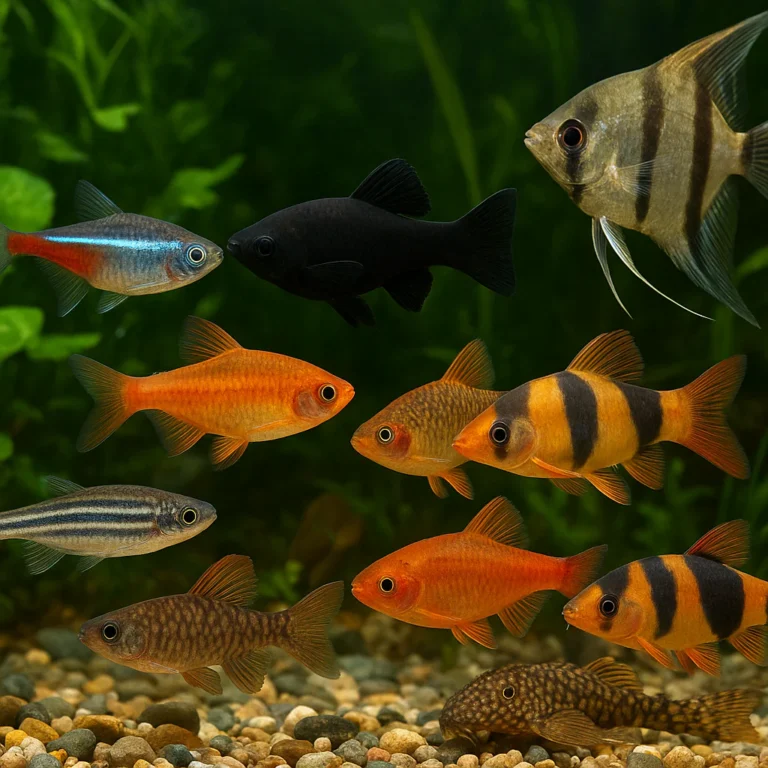
The best tropical fish species for aquariums are not simply the brightest fish in the store—they are the species that match your tank’s adult size, water chemistry, temperament, and maintenance routine. For most community aquariums, we recommend starting with peaceful, adaptable choices such as harlequin rasboras, neon tetras, cherry barbs, Corydoras, honey gouramis, guppies, and kuhli loaches.
We learned this lesson after watching a tiny juvenile pleco transform from a charming “cleanup crew” purchase into a surprisingly substantial fish with a serious appetite and an even larger waste output. The store tank showed the fish you were buying; your aquarium eventually reveals the fish you actually need to plan for.
There are tropical fish for nearly every style of freshwater aquarium: colorful nano fish, active schooling species, personable centerpiece fish, bottom-dwelling catfish, planted-tank specialists, and advanced choices such as discus or German blue rams. The trick is composing a community where every fish has enough room, proper companions, and water it can tolerate long term.
Key Takeaways
- Choose fish for their adult size, not their juvenile appearance at the aquarium store.
- Peaceful community favorites include harlequin rasboras, neon tetras, cherry barbs, Corydoras, honey gouramis, guppies, platies, and kuhli loaches.
- Schooling and shoaling species need groups to feel secure and display natural behavior.
- Aquarium water parameters matter: temperature, pH, GH, KH, ammonia, nitrite, and nitrate all influence fish health.
- Cycle the aquarium before adding fish and quarantine new arrivals whenever possible.
- Match fish temperament carefully: tiger barbs, angelfish, cichlids, and betas may not suit a standard peaceful community tank.
- Plan the aquascape around fish behavior with plants, caves, open swimming areas, shade, and appropriate water flow.
- Avoid impulse purchases of large species such as clown loaches, common plecos, Oscars, discus, and Flowerhorn cichlids unless you can house their adult forms.
- Feed a varied, species-appropriate diet and maintain the aquarium consistently rather than relying on “cleaner fish.”
- The best tropical aquarium is a balanced ecosystem, not a crowded collection of attractive fish.
Table of Contents
- ⚡️ Quick Tips and Facts About Tropical Aquarium Fish
- 🌿 Tropical Fishkeeping: Origins, Habitats, and Aquarium History
- 🐠 Best Tropical Fish Species for Aquariums
- 1. Neon Tetra
- 2. Cardinal Tetra
- 3. Ember Tetra
- 4. Harlequin Rasbora
- 5. Zebra Danio
- 6. Guppy
- 7. Endler’s Livebearer
- 8. Platy
- 9. Swordtail
- 10. Mollies
- 11. Beta Fish
- 12. Honey Gourami
- 13. Pearl Gourami
- 14. German Blue Ram
- 15. Kribensis Cichlid
- 16. Angelfish
- 17. Discus Fish
- 18. Bolivian Ram
- 19. Corydoras Catfish
- 20. Otocinclus Catfish
- 21. Bristlenose Pleco
- 22. Kuhli Loach
- 23. Clown Loach
- 24. Cherry Barb
- 25. Tiger Barb
- 26. Rainbowfish
- 27. Killifish
- 28. African Butterfly Fish
- 29. Freshwater Angelfish
- 30. Flowerhorn Cichlid
- 📊 Tropical Fish Comparison Chart: Size, Temperament, and Difficulty
- 🧪 Aquarium Water Parameters for Tropical Fish
- Ideal Temperature, pH, GH, and KH
- Community Tank Water Chemistry
- How to Test Aquarium Water Correctly
- 🏡 Choosing the Right Aquarium Size and Shape
- Best Tropical Fish for Nano Aquariums
- Tropical Fish for 20-Gallon Aquariums
- Tropical Fish for 29-, 40-, and 55-Gallon Tanks
- Large Tropical Fish Aquariums
- 🌱 Tropical Planted Aquarium Setup
- Substrate, Hardscape, and Aquascaping Ideas
- Best Live Plants for Tropical Fish
- Lighting, Filtration, and Water Flow
- Heaters, Thermometers, and Essential Equipment
- 🤝 Tropical Fish Compatibility and Community Tank Planning
- Peaceful Community Fish Combinations
- Semi-Aggressive and Territorial Tropical Fish
- Fish That Should Not Be Kept Together
- Schooling, Shoaling, and Pairing Requirements
- Bottom-Dwelling and Top-Dwelling Tank Mates
- 🍽️ Tropical Fish Food and Feeding Guide
- Flakes, Pelets, Wafers, Frozen, and Live Foods
- Feding Schedules by Fish Type
- How to Prevent Overfeeding and Water Pollution
- 🧼 Aquarium Maintenance Routine
- Daily, Weekly, and Monthly Fish Tank Tasks
- Water Changes and Gravel Cleaning
- Filter Maintenance Without Killing Beneficial Bacteria
- 🦠 Tropical Fish Diseases, Parasites, and Health Problems
- Ich, Fin Rot, Velvet, and Fungal Infections
- Swim Bladder Problems and Dropsy
- Quarantine Procedures for New Fish
- When and How to Use Aquarium Medications
- 🛒 How to Choose Healthy Tropical Fish
- Signs of a Healthy Fish at the Aquarium Store
- Wild-Caught Versus Captive-Bred Fish
- Responsible Fishkeeping and Ethical Sourcing
- 🧬 Tropical Fish Breding and Fry Care
- Livebearers: Guppies, Platies, Mollies, and Swordtails
- Egg-Laying Tropical Fish
- Breding Community Fish Without Losing the Fry
- 🏆 Best Tropical Fish by Experience Level
- Easy Tropical Fish for Beginners
- Intermediate Aquarium Fish
- Advanced Tropical Fish for Experienced Aquarists
- 🎨 Best Tropical Fish by Aquarium Style
- Colorful Tropical Fish
- Small Tropical Fish
- Peaceful Tropical Fish
- Active Tropical Fish
- Tropical Fish for Heavily Planted Tanks
- Tropical Fish for Biotope Aquariums
- ⚠️ Common Tropical Fishkeeping Mistakes
- 💡 Smart Aquarium Tips for Better Fish Behavior
- ❓ Frequently Asked Questions About Tropical Fish Species for Aquariums
- ✅ Conclusion: Choosing the Best Tropical Fish for Your Aquarium
- 🔗 Recommended Links for Tropical Fishkeepers
- ❔ FAQ
- 📚 Reference Links
Quick Tips and Facts About Tropical Aquarium Fish
Welcome to Aquarium Music™, where we believe a great aquarium should look like a living orchestra: schooling tetras keep the rhythm, plants provide the stage, and one carefully chosen centerpiece fish takes the solo. 🎶🐠
If you are wondering which tropical fish species for aquariums will actually thrive in your tank, start with this rule: choose fish for their adult size, behavior, social needs, and water requirements, not just their juvenile appearance at the store.
Before buying your first fish, read our guide on how often you should clean your fish tank because maintenance—not a lucky fish choice—is what keeps the whole performance in tune.
The fastest route to a healthy tropical aquarium
- Cycle the aquarium before adding fish. Beneficial bacteria convert toxic ammonia into nitrite and then nitrate. The U.S. Environmental Protection Agency explains the nitrogen cycle and aquatic ammonia toxicity.
- Install a reliable heater and thermometer. Most popular tropical freshwater fish do well around 75–80°F (24–27°C), but species-specific requirements vary.
- Test ammonia, nitrite, nitrate, pH, GH, and KH. A tank can look crystal-clear while chemistry quietly causes gill damage.
- Stock by behavior and adult size. A 2-inch Oscar is still an eventual 12-inch-plus predator, not a nano-tank roommate.
- Keep schooling fish in proper groups. Six neon tetras is a starting point; a pair of lonely “schooling” fish is more awkward than a two-person marching band.
- Quarantine new arrivals. Two to four weeks in a separate tank can prevent one fish from turning your community aquarium into an emergency ward.
- Add plants, caves, and open swimming space. Good aquascaping reduces stress and gives timid fish somewhere to disappear besides behind the filter.
- Feed modestly. Uneaten food becomes pollution, and pollution becomes a chemistry problem with fins.
- Use a lid. Danios, livebearers, hatchetfish, and even startled plecos can launch themselves surprisingly well.
- Research local regulations. Some predatory fish, snakeheads, invasive species, and large exotics may be restricted.
Tropical freshwater fish: essential facts at a glance
| Fact | Practical meaning |
|---|---|
| Tropical fish are not one biological group | “Tropical” describes a warm-water care range, not a single family |
| Most community species need stable heat | Suden temperature swings are more dangerous than a slightly imperfect but stable reading |
| Fish produce waste continuously | Filtration and water changes are essential, even in planted tanks |
| Schooling behavior is species-specific | Tetras, rasboras, danios, barbs, Corydoras, and rainbowfish need different group sizes |
| Adult size determines stocking | Always plan for the fish you will have, not the fish you bought |
| Plants improve habitat quality | They offer cover and may absorb nutrients, but they do not replace filtration |
| “Easy” does not mean maintenance-free | Hardy fish still need cycled water, appropriate food, and regular testing |
| Saltwater and freshwater are different systems | Most species in this guide are tropical freshwater fish |
Our three-question pre-purchase test
Before you bring home any tropical fish, ask:
- Can my aquarium hold the adult fish comfortably?
- Can my water chemistry match its needs without constant correction?
- Can I provide its social group, diet, cover, and tank mates?
If any answer is “not yet,” wait. At Aquarium Music™, we have seen more fishkeeping problems caused by an attractive impulse purchase than by a genuinely difficult species.
The big question is coming: which fish belong in your aquarium’s particular “instrument section”? To answer it properly, we need to look at where these fish come from and why their natural habitats matter.
Tropical Fishkeeping: Origins, Habitats, and Aquarium History

Tropical aquarium fish come from warm freshwater habitats across South America, Central America, Africa, Southeast Asia, India, and Australia. Their natural homes include rainforest streams, floodplain pools, blackwater rivers, rocky rift lakes, rice fields, forest swamps, and fast-flowing mountain creks.
The phrase “tropical fish” sounds simple, but a blackwater cardinal tetra and a hard-water African mbuna have very different expectations. Both may appreciate warm water. They do not, however, share the same geological address—or the same aquarium shopping list.
Where popular tropical fish originate
| Region | Typical habitat | Aquarium examples | Common setup clues |
|---|---|---|---|
| Amazon and Orinoco basins | Warm, slow blackwater and clearwater streams | Tetras, angelfish, discus, Corydoras, dwarf cichlids | Driftwood, leaf litter, plants, subdued lighting |
| Central America | Rivers, lakes, and rocky shorelines | Platies, swordtails, convict cichlids, livebearers | Open swimming space, moderate to hard water |
| West Africa | Forest streams and seasonal pools | Kribensis, African tetras, butterflyfish | Cover, roots, floating plants |
| East African Rift Lakes | Hard, alkaline rocky habitats | Mbuna, peacocks, shell dwellers | Rockwork, alkaline water, species-specific stocking |
| Southeast Asia | Rice paddies, peat swamps, and forest streams | Bettas, gouramis, rasboras, kuhli loaches | Dense vegetation, gentle flow, shaded areas |
| Australia and New Guinea | Clear creks, billabongs, and coastal streams | Rainbowfish, blue-eyes, gudgeons | Open swimming room, oxygenation, group stocking |
The Encyclopaedia Britannica overview of tropical freshwater ecosystems helps explain why warm regions can produce such varied aquatic habitats: rainfall patterns, vegetation, mineral content, flow, and seasonal flooding all shape water chemistry.
Blackwater, clearwater, and whitewater habitats
Blackwater aquariums
Blackwater streams are often stained amber or tea-brown by tannins from leaves, wood, and decomposing vegetation. They may be:
- Soft in mineral content
- Acidic or mildly acidic
- Dimly lit beneath forest canopy
- Rich in submerged roots and leaf litter
- Lower in visible algae
Suitable inhabitants may include:
- Cardinal tetras
- Ember tetras
- Rummy-nose tetras
- Apistograma
- Discus
- Some wild-type betas
- Corydoras species
A blackwater biotope does not require turning your aquarium into a cup of tea overnight. Add botanicals gradually, monitor pH and KH, and remember that tannins are not a substitute for water quality.
Clearwater aquariums
Clearwater environments may have:
- Better visibility
- Moderate current
- More mineral content than blackwater systems
- Rocky or sandy bottoms
- Dense marginal vegetation
Many community aquariums loosely mimic clearwater habitats because they offer a practical compromise: attractive plants, visible fish, moderate filtration, and manageable chemistry.
Whitewater and floodplain systems
Whitewater rivers carry more suspended sediment and minerals. Floodplain habitats can change dramatically with rainy and dry seasons. Livebearers, larger characins, and some cichlids may tolerate broader conditions, but tolerance should never be mistaken for permission to neglect maintenance.
What the hobby learned from wild habitats
The first aquariums were limited by lighting, filtration, temperature control, and water transport. Modern equipment changed the hobby dramatically:
- Thermostatic heaters made warm-water fish more practical.
- Sponge and biological filters made ammonia control more reliable.
- LED lighting made planted aquariums more accessible.
- Captive breeding produced fish better adapted to domestic conditions.
- Commercial foods improved nutrition and convenience.
- Online fishkeeping communities expanded species knowledge, though not every confident forum post deserves a lab coat.
The Smithsonian’s National Zoo discussion of freshwater ecosystems provides useful context on how fish adaptations reflect habitat conditions. That connection matters in your living room: a surface-oriented killifish, a cave-loving kuhli loach, and a current-loving hillstream loach cannot be managed as identical “warm-water fish.”
The featured video’s useful organizing idea
The first YouTube video in this article groups tropical fish by practical aquarium roles:
- Schooling and shoaling fish for movement and group behavior
- Centerpiece fish for visual focus
- Bottom dwellers for lower-level activity
- Peaceful and aggressive species requiring different community plans
We like this framework because it helps beginners think in layers. However, a visual category is only the opening note. The full composition still depends on tank footprint, adult size, filtration, temperament, and water chemistry.
Best Tropical Fish Species for Aquariums
There is no single “best” tropical fish. There is only the best match for your aquarium, experience, water, maintenance habits, and preferred style.
Below, we have organized popular species by the role they play in an aquarium. The ratings are Aquarium Music™ experience-based scores on a 1–10 scale, not laboratory measurements. A fish scoring 10 for color may score 4 for beginner suitability. Beauty and practicality do not always share a tank.
1. Neon Tetra
Scientific name: Paracheirodon inesi
Adult size: About 1.5 inches
Recommended group: At least 6; 8–12 often looks and behaves better
Temperature: Approximately 68–79°F (20–26°C)
pH: Commonly 6.0–7.0
Temperament: Peaceful
| Category | Aquarium Music™ rating |
|---|---|
| Color | 9/10 |
| Community compatibility | 9/10 |
| Beginner suitability | 8/10 |
| Hardiness | 7/10 |
| Planted-tank appeal | 10/10 |
| Breding difficulty | 4/10 |
Neon tetras are classic community fish because their blue-and-red coloration glows beneath aquarium lighting. The FishBase profile for Paracheirodon inesi provides taxonomic and biological reference information.
Best setup:
- Fine gravel or sand
- Driftwood and plants
- Open central swimming space
- Gentle to moderate current
- Peaceful tank mates of similar size
Benefits:
- Small adult size
- Peaceful behavior
- Excellent visual impact in groups
- Comfortable in planted aquariums
Drawbacks:
- Poor-quality or stressed specimens may be vulnerable to disease
- They can disappear into a large community tank
- They are not ideal with large angelfish, cichlids, or predatory fish
The commonly cited community recommendation is to keep neon tetras in groups of at least six. We agree, but in a larger aquarium, a dozen or more often creates a much more natural, confident shoal.
2. Cardinal Tetra
Scientific name: Paracheirodon axelrodi
Adult size: About 2 inches
Recommended group: 8 or more
Temperature: Approximately 73–82°F (23–28°C)
pH: Often acidic to neutral
Temperament: Peaceful
Cardinal tetras display red coloration along nearly the entire lower body, making them especially dramatic in a planted or blackwater aquarium.
| Category | Aquarium Music™ rating |
|---|---|
| Color | 10/10 |
| Community compatibility | 9/10 |
| Beginner suitability | 7/10 |
| Hardiness | 7/10 |
| Planted-tank appeal | 10/10 |
| Breding difficulty | 4/10 |
They prefer stable warm water and should not be selected simply because they look like “larger neon tetras.” Their care overlap is considerable, but cardinals generally suit warmer South American community layouts.
3. Ember Tetra
Scientific name: Hyphessobrycon amandae
Adult size: About 0.8 inch
Recommended group: 8–12
Temperature: Approximately 75–82°F (24–28°C)
pH: Often 5.0–7.0
Temperament: Peaceful
Ember tetras are tiny orange sparks—ideal for nano-to-medium planted aquariums that do not contain large, boisterous fish.
| Category | Aquarium Music™ rating |
|---|---|
| Color | 9/10 |
| Community compatibility | 9/10 |
| Beginner suitability | 8/10 |
| Hardiness | 7/10 |
| Nano-tank suitability | 8/10 |
| Breding difficulty | 5/10 |
The species may live for many years with excellent care, as summarized in FishBase’s ember tetra reference. Their small size is both their charm and their vulnerability. Avoid:
- Large gouramis
- Adult angelfish
- Predatory cichlids
- Boisterous barbs
- Excessively strong flow
4. Harlequin Rasbora
Scientific name: Trigonostigma heteromorpha
Adult size: About 2 inches
Recommended group: 6–10
Temperature: Approximately 72–81°F (22–27°C)
pH: Commonly 6.0–7.5
Temperament: Peaceful
Harlequin rasboras offer copper-orange bodies and a bold black wedge. They are among our favorite “movement fish” for planted community aquariums.
| Category | Aquarium Music™ rating |
|---|---|
| Color | 8/10 |
| Community compatibility | 9/10 |
| Beginner suitability | 9/10 |
| Hardiness | 9/10 |
| Planted-tank appeal | 9/10 |
| Breding difficulty | 5/10 |
They are less fragile-looking than ember tetras and less flashy than cardinal tetras, but their calm group movement is wonderfully reliable. A school weaving through Cryptocoryne leaves can make an ordinary aquarium feel remarkably intentional.
5. Zebra Danio
Scientific name: Danio rerio
Adult size: About 2 inches
Recommended group: 6 or more
Temperature: Approximately 64–77°F (18–25°C)
pH: Roughly 6.5–7.5
Temperament: Peaceful but highly active
| Category | Aquarium Music™ rating |
|---|---|
| Activity level | 10/10 |
| Community compatibility | 8/10 |
| Beginner suitability | 10/10 |
| Hardiness | 10/10 |
| Planted-tank appeal | 8/10 |
| Breding difficulty | 7/10 |
Zebra danios are fast, hardy, and constantly in motion. They can be excellent for beginners, but their energy may overwhelm shy fish or slow-moving long-finned species.
Use a tight lid. Danios are accomplished jumpers. The University of Wisconsin’s zebrafish care resources also reflect how widely this species is studied and maintained under controlled conditions.
6. Guppy
Scientific name: Poecilia reticulata
Adult size: About 2 inches
Recommended ratio: One male to at least two females
Temperature: Approximately 72–82°F (22–28°C)
pH: Commonly 7.0–8.0
Temperament: Generally peaceful
| Category | Aquarium Music™ rating |
|---|---|
| Color variety | 10/10 |
| Community compatibility | 8/10 |
| Beginner suitability | 9/10 |
| Hardiness | 8/10 |
| Breding ease | 10/10 |
| Population control | 3/10 |
Guppies are colorful, active, and prolific. That last word is doing heavy lifting. A trio can become a population explosion with remarkable efficiency.
Advantages:
- Huge range of colors and tail shapes
- Easy to observe
- Generally adaptable
- Readily captive-bred
- Suitable for many peaceful community aquariums
Drawbacks:
- Fancy strains can be less robust
- Males may constantly court females
- Fry quickly create overstocking
- Long fins can attract fin-nipping tank mates
For more species-specific care, browse our Fish Care and Species Profiles category.
7. Endler’s Livebearer
Scientific name: Poecilia wingei
Adult size: About 1.5 inches
Recommended group: 6 or more
Temperature: Approximately 72–82°F (22–28°C)
pH: Neutral to alkaline
Temperament: Peaceful
Endler’s livebearers are smaller and often more streamlined than fancy guppies. Males show brilliant orange, green, black, and blue markings; females are larger and more subdued.
| Category | Aquarium Music™ rating |
|---|---|
| Color | 9/10 |
| Nano suitability | 8/10 |
| Beginner suitability | 9/10 |
| Hardiness | 8/10 |
| Breding ease | 10/10 |
| Population control | 3/10 |
They are excellent for planted nano aquariums, but you still need a plan for fry. Consider a single-sex male group if you want color without turning your aquarium into a livebearer nursery.
8. Platy
Scientific name: Xiphophorus maculatus and related species
Adult size: About 2.5 inches
Recommended ratio: One male to two or three females
Temperature: Approximately 70–80°F (21–27°C)
pH: Often 7.0–8.2
Temperament: Peaceful
| Category | Aquarium Music™ rating |
|---|---|
| Color variety | 9/10 |
| Community compatibility | 9/10 |
| Beginner suitability | 10/10 |
| Hardiness | 9/10 |
| Breding ease | 10/10 |
| Plant safety | 8/10 |
Platies are cheerful, sturdy community fish. They do well in moderately hard, alkaline water, making them a useful choice where soft-water tetras may not be the natural fit.
Watch the population. Like guppies, platies are livebearers and can produce fry regularly.
9. Swordtail
Scientific name: Xiphophorus hellerii
Adult size: Males often around 4–5 inches including the tail extension
Recommended ratio: One male to two or more females
Temperature: Approximately 72–79°F (22–26°C)
pH: Commonly 7.0–8.3
Temperament: Peaceful to mildly boisterous
Swordtails are lively, attractive, and larger than many beginners expect.
| Category | Aquarium Music™ rating |
|---|---|
| Appearance | 9/10 |
| Community compatibility | 8/10 |
| Beginner suitability | 9/10 |
| Hardiness | 9/10 |
| Breding ease | 10/10 |
| Small-tank suitability | 5/10 |
Provide an aquarium with a long horizontal footprint. A tall, narrow tank may look elegant, but swordtails want room to cruise.
10. Mollies
Common species: Poecilia sphenops, P. latipinna, P. velifera
Adult size: Approximately 3–6 inches depending on species and variety
Temperature: Roughly 72–82°F (22–28°C)
pH: Commonly 7.5–8.5
Temperament: Usually peaceful
| Category | Aquarium Music™ rating |
|---|---|
| Color variety | 9/10 |
| Community compatibility | 8/10 |
| Beginner suitability | 8/10 |
| Hardiness | 8/10 |
| Breding ease | 10/10 |
| Small-tank suitability | 4/10 |
Mollies are often sold as easy community fish, and many are. However, they benefit from:
- Harder, mineral-rich water
- Strong filtration
- Good oxygenation
- More swimming space than their store size suggests
- A balanced vegetable-inclusive diet
Sailfin mollies become particularly large and may need a substantially larger aquarium than standard black mollies.
11. Beta Fish
Scientific name: Beta splendens
Adult size: About 2.5–3 inches
Recommended setup: Species-specific aquarium with gentle flow and cover
Temperature: Approximately 76–82°F (24–28°C)
pH: Roughly 6.5–7.5
Temperament: Males are usually aggressive toward other males
| Category | Aquarium Music™ rating |
|---|---|
| Color and finnage | 10/10 |
| Personality | 10/10 |
| Beginner suitability | 8/10 |
| Community compatibility | 5/10 |
| Small-aquarium suitability | 8/10 |
| Hardiness under proper care | 7/10 |
The Smithsonian’s National Zoo beta information supports the species’ reputation for territorial behavior and labyrinth-breathing adaptations.
The critical message from Dustin’s Fish Tanks is worth repeating: betas do not belong in decorative cups for long-term care. Their labyrinth organ helps them breathe atmospheric air, but it does not eliminate the need for clean, warm, filtered water.
A good beta setup includes:
- A properly cycled aquarium
- Gentle filtration or a baffled outlet
- A heater
- Broad-leaved plants or resting spots
- A secure lid
- Calm tank mates, if the individual fish permits them
Potential tank mates:
- Nerite snails
- Amano shrimp, with caution
- Peaceful bottom dwellers in a sufficiently large aquarium
- Small, calm community fish
Avoid:
- Another male beta
- Fin-nipping barbs
- Aggressive gouramis
- Fish that constantly invade the beta’s resting areas
👉 CHECK PRICE on:
- Fluval Beta Aquarium Kits: Amazon | Fluval Official Website
- Aqueon Beta Filters and Heaters: Amazon | Aqueon Official Website
12. Honey Gourami
Scientific name: Trichogaster chuna
Adult size: About 2 inches
Recommended group: Pair or small group in a suitable aquarium
Temperature: Approximately 74–82°F (23–28°C)
pH: About 6.0–7.5
Temperament: Peaceful
| Category | Aquarium Music™ rating |
|---|---|
| Color | 9/10 |
| Community compatibility | 9/10 |
| Beginner suitability | 8/10 |
| Planted-tank appeal | 10/10 |
| Personality | 9/10 |
| Breding difficulty | 6/10 |
Honey gouramis are gentle centerpiece fish for planted community aquariums. They appreciate:
- Floating plants
- Slow water movement
- Dense cover
- A quiet upper and middle water column
- Small peaceful tank mates
They can be confused with color-enhanced or misidentified dwarf gouramis, so buy from a reputable seller and inspect the fish carefully.
13. Pearl Gourami
Scientific name: Trichopodus leerii
Adult size: Approximately 4–5 inches
Recommended aquarium: Medium to large planted tank
Temperature: Approximately 77–82°F (25–28°C)
pH: Roughly 6.0–7.5
Temperament: Generally peaceful
| Category | Aquarium Music™ rating |
|---|---|
| Appearance | 10/10 |
| Community compatibility | 8/10 |
| Beginner suitability | 7/10 |
| Planted-tank appeal | 10/10 |
| Personality | 9/10 |
| Small-tank suitability | 4/10 |
Pearl gouramis are graceful, patterned, and far more substantial than honey gouramis. Give them:
- A planted aquarium
- Gentle flow
- Surface access
- Hiding places
- Compatible tank mates that do not nip their feeler-like pelvic fins
14. German Blue Ram
Scientific name: Mikrogeophagus ramirezi
Adult size: About 2.5–3 inches
Recommended aquarium: Stable, mature aquarium
Temperature: Approximately 78–85°F (26–29°C)
pH: Often 6.0–7.5
Temperament: Peaceful to territorial when spawning
| Category | Aquarium Music™ rating |
|---|---|
| Color | 10/10 |
| Community compatibility | 7/10 |
| Beginner suitability | 4/10 |
| Water-stability requirement | 10/10 |
| Planted-tank appeal | 9/10 |
| Breding difficulty | 7/10 |
German blue rams are spectacular but should not be marketed as effortless beginner fish. They need:
- Warm water
- Excellent filtration
- Low nitrate
- Stable chemistry
- High-quality food
- A mature aquarium
- Careful sourcing
The FishBase profile for Mikrogeophagus ramirezi provides taxonomic reference material, while experienced aquarists often emphasize that commercially bred strains may be sensitive.
Our recommendation: choose a healthy, captive-bred pair only after you have mastered stable water quality. The color is the reward; the consistency is the entry fee.
15. Kribensis Cichlid
Scientific name: Pelvicachromis pulcher
Adult size: Approximately 3–4 inches
Recommended aquarium: 20 gallons or larger for a pair, with cave structure
Temperature: Approximately 75–80°F (24–27°C)
pH: Roughly 6.0–8.0
Temperament: Peaceful to territorial, especially while breeding
| Category | Aquarium Music™ rating |
|---|---|
| Color | 9/10 |
| Personality | 10/10 |
| Beginner suitability | 8/10 |
| Community compatibility | 7/10 |
| Breding ease | 9/10 |
| Small-tank suitability | 6/10 |
Kribensis are one of our favorite beginner-friendly cichlids because they display parental behavior and personality without requiring an enormous aquarium.
Provide:
- A cave or coconut shelter
- Visual barriers
- Sand or fine gravel
- Plants rooted away from the spawning cave
- Tank mates that can avoid their defended territory
Once a pair has fry, their “peaceful community fish” résumé may temporarily acquire a bold red asterisk.
16. Angelfish
Scientific name: Pterophyllum scalare
Adult size: Body length around 6 inches, with fins creating much greater height
Recommended aquarium: Tall, spacious aquarium; 55 gallons is a common practical starting point for groups or community planning
Temperature: Approximately 75–82°F (24–28°C)
pH: Often 6.0–7.5
Temperament: Peaceful to territorial
| Category | Aquarium Music™ rating |
|---|---|
| Appearance | 10/10 |
| Community compatibility | 7/10 |
| Beginner suitability | 6/10 |
| Planted-tank appeal | 10/10 |
| Personality | 9/10 |
| Small-tank suitability | 2/10 |
Angelfish are the classic example of why height and footprint both matter. The tall-tank discussion from Dustin’s Fish Tanks is useful here: vertical aquariums create an impressive water column, but they can be harder to clean and may provide less horizontal swimming room.
Angelfish benefits:
- Dramatic silhouette
- Strong personality
- Excellent centerpiece potential
- Beautiful interaction with tall plants and wood
Drawbacks:
- May eat small tetras
- Can become territorial
- Pair formation can disrupt a community aquarium
- Juveniles are often sold far below adult size
Suitable companions may include:
- Larger peaceful tetras
- Corydoras
- Peaceful larger rasboras
- Mature bristlenose plecos
- Some peaceful gouramis, depending on temperament
Avoid combining adult angelfish with tiny ember tetras, shrimp, or fish that nip their trailing fins.
17. Discus Fish
Scientific name: Symphysodon species
Adult size: Approximately 6 inches or more in diameter
Recommended aquarium: Large, mature, stable aquarium
Temperature: Often 82–86°F (28–30°C)
pH: Usually acidic to neutral, depending on strain and source
Temperament: Peaceful but socially demanding
| Category | Aquarium Music™ rating |
|---|---|
| Appearance | 10/10 |
| Community compatibility | 7/10 |
| Beginner suitability | 3/10 |
| Water-stability requirement | 10/10 |
| Planted-tank appeal | 9/10 |
| Breding difficulty | 8/10 |
Discus are not impossible, but they punish inconsistency. Their warm-water requirements also narrow the choice of compatible community fish.
Prioritize:
- Large water volume
- Excellent biological filtration
- Frequent maintenance
- High-quality food
- Groups rather than isolated individuals
- Warm, stable temperature
A planted discus aquarium can be stunning, but remember that many common aquatic plants prefer cooler water. Select warm-tolerant plants or design a simpler bare-bottom grow-out system.
18. Bolivian Ram
Scientific name: Mikrogeophagus altispinosus
Adult size: Approximately 3 inches
Recommended aquarium: 20 gallons or larger for a pair
Temperature: Approximately 75–82°F (24–28°C)
pH: Roughly 6.0–7.5
Temperament: Generally peaceful
Bolivian rams are often more forgiving than German blue rams and make excellent South American community fish.
| Category | Aquarium Music™ rating |
|---|---|
| Appearance | 8/10 |
| Community compatibility | 9/10 |
| Beginner suitability | 7/10 |
| Hardiness | 8/10 |
| Planted-tank appeal | 9/10 |
| Breding difficulty | 7/10 |
They appreciate:
- Sand or smooth substrate
- Wood and plants
- Moderate current
- Open bottom territory
- Peaceful midwater companions
19. Corydoras Catfish
Common species: Corydoras aeneus, C. panda, C. sterbai, C. paleatus, and many others
Adult size: Roughly 1–3 inches depending on species
Recommended group: At least 6 of the same species
Temperature: Species-dependent
pH: Usually mildly acidic to neutral, though captive-bred fish may tolerate broader ranges
Temperament: Peaceful
| Category | Aquarium Music™ rating |
|---|---|
| Community compatibility | 10/10 |
| Beginner suitability | 9/10 |
| Personality | 10/10 |
| Planted-tank appeal | 9/10 |
| Hardiness | 8/10 |
| Breding difficulty | 6/10 |
Corydoras are peaceful bottom-dwelling catfish that use their barbels to explore the substrate. They are not “clean-up machines,” however. They still need deliberate feeding with sinking wafers, micro-pelets, frozen foods, or other appropriate diets.
Important care points:
- Keep a proper group.
- Use smooth sand or rounded gravel.
- Avoid sharp substrate that can damage barbels.
- Ensure food reaches the bottom.
- Provide shaded cover and resting areas.
- Never rely on leftover flakes as their complete diet.
The FishBase Corydoras genus reference illustrates how diverse this group is. A panda cory and a sterbai cory are not interchangeable in temperature preferences.
20. Otocinclus Catfish
Common genus: Otocinclus
Adult size: Approximately 1.5–2 inches
Recommended group: 6 or more
Temperature: Often 72–79°F (22–26°C)
pH: Usually mildly acidic to neutral
Temperament: Peaceful
| Category | Aquarium Music™ rating |
|---|---|
| Algae-grazing behavior | 9/10 |
| Community compatibility | 10/10 |
| Beginner suitability | 5/10 |
| Planted-tank appeal | 10/10 |
| Hardiness after acclimation | 5/10 |
| Breding difficulty | 7/10 |
Otocinclus are delightful algae grazers, but the phrase “easy algae eater” has caused many empty aquariums. They need:
- A mature tank
- Natural algae and biofilm
- Supplemental vegetables or algae wafers
- Excellent oxygenation
- Gentle acclimation
- Peaceful companions
Do not add a group of otos to a newly set-up aquarium because the glass looks a little green. That is not a buffet; it is a shortage of infrastructure.
21. Bristlenose Pleco
Scientific name: Ancistrus species
Adult size: Approximately 4–6 inches
Recommended aquarium: Generally 30 gallons or larger, depending on species and stocking
Temperature: Approximately 74–80°F (23–27°C)
pH: Roughly 6.5–7.5
Temperament: Usually peaceful
| Category | Aquarium Music™ rating |
|---|---|
| Community compatibility | 9/10 |
| Beginner suitability | 8/10 |
| Algae grazing | 8/10 |
| Bioload management | 5/10 |
| Personality | 9/10 |
| Breding ease | 8/10 |
Bristlenose plecos are much more practical than common plecos for many home aquariums, but they still produce considerable waste and need wood, hiding spots, and a varied diet.
Feed:
- Sinking algae wafers
- Blanched zucchini
- Cucumber
- Quality bottom-feder pellets
- Occasional protein-rich foods
- Driftwood for grazing and structure
They do not eliminate the need for scraping glass or changing water. No fish is a maintenance employee with a tiny apron.
22. Kuhli Loach
Scientific name: Pangio semicincta and related species
Adult size: About 4 inches
Recommended group: 6 or more
Temperature: Approximately 75–86°F (24–30°C)
pH: Often 5.5–7.0
Temperament: Peaceful, shy, nocturnal
| Category | Aquarium Music™ rating |
|---|---|
| Personality | 10/10 |
| Community compatibility | 10/10 |
| Beginner suitability | 8/10 |
| Planted-tank appeal | 9/10 |
| Visibility | 5/10 |
| Breding difficulty | 3/10 |
Kuhli loaches resemble animated noodles and spend much of their time weaving through plants, wood, and substrate.
Best setup:
- Fine sand
- Leaf litter or smooth décor
- Numerous hiding places
- Dimer areas
- Secure cover
- Sinking foods offered after lights-out
A single kuhli loach is a lonely noodle. Keep a group.
23. Clown Loach
Scientific name: Chromobotia macracanthus
Adult size: Can exceed 10–12 inches
Recommended aquarium: Very large aquarium for adults
Temperature: Approximately 77–86°F (25–30°C)
pH: Roughly 6.0–7.5
Temperament: Social, active, generally peaceful
| Category | Appearance | 10/10 |
|---|---|---|
| Social behavior | 10/10 | |
| Community compatibility | 8/10 | |
| Beginner suitability | 3/10 | |
| Adult-size practicality | 2/10 | |
| Small-tank suitability | 1/10 |
Clown loaches are frequently purchased as small striped juveniles and later become a serious space commitment. Their charming shop size is not their final form.
Do not buy clown loaches for a typical small community aquarium. If you cannot plan for a group of large adult fish and the filtration required for them, choose zebra loaches or a suitable small Corydoras species instead.
24. Cherry Barb
Scientific name: Puntius titeya
Adult size: About 2 inches
Recommended group: 6 or more
Temperature: Approximately 72–80°F (22–27°C)
pH: Around 6.0–8.0
Temperament: Peaceful
| Category | Aquarium Music™ rating |
|---|---|
| Color | 8/10 |
| Community compatibility | 9/10 |
| Beginner suitability | 9/10 |
| Hardiness | 9/10 |
| Planted-tank appeal | 9/10 |
| Breding difficulty | 7/10 |
Cherry barbs are among the safest barb choices for peaceful community aquariums. Males develop richer red coloration when displaying, especially against green plants.
Unlike tiger barbs, cherry barbs rarely turn a community aquarium into a fin-nipping courtroom.
25. Tiger Barb
Scientific name: Puntigrus tetrazona
Adult size: About 3 inches
Recommended group: 8–10 or more
Temperature: Approximately 74–82°F (23–28°C)
pH: Roughly 6.0–8.0
Temperament: Active, semi-agressive, fin-nipping risk
| Category | Aquarium Music™ rating |
|---|---|
| Appearance | 9/10 |
| Activity level | 10/10 |
| Community compatibility | 6/10 |
| Beginner suitability | 7/10 |
| Hardiness | 9/10 |
| Long-finned-tank suitability | 2/10 |
Tiger barbs behave better in larger groups because aggression is spread across the shoal. Even then, do not combine them casually with:
- Bettas
- Angelfish
- Long-finned guppies
- Slow gouramis
- Fancy goldfish
Their bold stripes and energetic behavior are excellent in a species-focused or carefully planned active community aquarium.
26. Rainbowfish
Popular species: Melanotaenia praecox, M. boesemani, M. lacustris, Iriatherina werneri
Adult size: Approximately 1.5–5 inches depending on species
Recommended group: 6 or more; some blue-eyes do best in 8–10
Temperature: Species-dependent
pH: Often neutral to moderately alkaline
Temperament: Peaceful, active
| Category | Aquarium Music™ rating |
|---|---|
| Color | 10/10 |
| Activity level | 10/10 |
| Community compatibility | 9/10 |
| Beginner suitability | 8/10 |
| Large-tank suitability | 10/10 |
| Nano-tank suitability | 4/10 |
Rainbowfish need more swimming room than their body length suggests. They are active, open-water fish and look best in long aquariums.
Good options by aquarium scale:
- Smaller blue-eyes for carefully designed smaller tanks
- Dwarf neon rainbowfish for medium aquariums
- Boesemani and larger rainbowfish for spacious tanks
Research conservation and sourcing information through the IUCN Red List because some wild rainbowfish populations face habitat pressure.
27. Killifish
Common aquarium groups: Aphyosemion, Fundulopanchax, Epiplatys, and others
Adult size: Approximately 1.5–4 inches depending on species
Recommended aquarium: Species-specific
Temperature: Often moderate tropical temperatures
pH: Species-specific
Temperament: Usually peaceful, sometimes territorial
| Category | Aquarium Music™ rating |
|---|---|
| Color | 10/10 |
| Surface activity | 9/10 |
| Beginner suitability | 6/10 |
| Community compatibility | 6/10 |
| Breding interest | 10/10 |
| Jumping risk | 2/10 |
Killifish are among the most colorful freshwater aquarium fish, but they often require a tight lid. Many are exceptional jumpers, and some have specialized breeding cycles linked to seasonal pools.
Best for:
- Species-specific aquariums
- Experienced nano fishkeepers
- Breding projects
- Aquarists who enjoy unusual behavior
28. African Butterfly Fish
Scientific name: Pantodon bucholzi
Adult size: Approximately 4 inches
Recommended aquarium: Spacious, covered aquarium with calm surface
Temperature: Approximately 75–86°F (24–30°C)
pH: Often mildly acidic to neutral
Temperament: Predatory toward small surface fish
| Category | Aquarium Music™ rating |
|---|---|
| Appearance | 9/10 |
| Beginner suitability | 4/10 |
| Community compatibility | 4/10 |
| Surface behavior | 10/10 |
| Jumping risk | 1/10 |
| Specialist-care appeal | 9/10 |
African butterflyfish need a secure lid and surface-oriented setup. They may eat small fish, insects, and anything that fits their mouth. Their unusual appearance is compelling, but they are not a standard community fish.
29. Freshwater Angelfish
The list above includes freshwater angelfish under Pterophyllum scalare, but the distinction matters: “angelfish” in the freshwater aquarium trade generally refers to Pterophyllum, not marine angelfish.
For detailed habitat planning, visit our Fish and Aquatic Life category.
30. Flowerhorn Cichlid
Type: Hybrid ornamental cichlid, not a naturally occurring species
Adult size: Commonly 10–16 inches, sometimes larger
Recommended aquarium: Large species-only or carefully planned aquarium
Temperature: Approximately 78–86°F (26–30°C)
pH: Often 7.0–8.0
Temperament: Highly territorial and aggressive
| Category | Aquarium Music™ rating |
|---|---|
| Appearance | 10/10 |
| Personality | 10/10 |
| Community compatibility | 2/10 |
| Beginner suitability | 4/10 |
| Adult-size practicality | 4/10 |
| Species-specific appeal | 10/10 |
Flowerhorns are intelligent, interactive, and visually dramatic. They are also aggressive, messy, and unsuitable for most community aquariums.
Plan for:
- Strong filtration
- Robust décor
- Large water volume
- Secure lids
- Species-specific stocking
- Careful handling
A Flowerhorn is not a “colorful community fish.” It is a centerpiece with a personality and a territorial policy.
Tropical Fish Comparison Chart: Size, Temperament, and Difficulty
The following table is a planning tool, not a substitute for species-specific research. “Minimum tank” varies by footprint, group size, filtration, and aquascape.
| Fish | Adult size | Group/social needs | Temperament | Suggested aquarium starting point | Care level |
|---|---|---|---|---|---|
| Neon tetra | 1.5 in | 6+ | Peaceful | 10 gal for a species group; larger for communities | Easy |
| Cardinal tetra | 2 in | 8+ | Peaceful | 20 gal long | Easy–moderate |
| Ember tetra | 0.8 in | 8+ | Peaceful | 10 gal planted | Easy–moderate |
| Harlequin rasbora | 2 in | 6+ | Peaceful | 15–20 gal | Easy |
| Zebra danio | 2 in | 6+ | Active, peaceful | 10–20 gal long | Easy |
| Guppy | 2 in | Trio or group | Peaceful | 10–20 gal | Easy |
| Endler’s livebearer | 1.5 in | Group | Peaceful | 10 gal planted | Easy |
| Platy | 2.5 in | Trio or group | Peaceful | 15–20 gal | Easy |
| Swordtail | 4–5 in | Group | Peaceful–boisterous | 30 gal long | Easy |
| Molly | 3–6 in | Group | Peaceful | 20–40+ gal | Easy–moderate |
| Beta | 3 in | Usually solitary | Territorial | 5–10 gal | Easy–moderate |
| Honey gourami | 2 in | Pair/group | Peaceful | 15–20 gal | Easy–moderate |
| Pearl gourami | 4–5 in | Pair/group | Peaceful | 40 gal | Moderate |
| German blue ram | 3 in | Pair | Territorial when breeding | 20 gal mature | Advanced |
| Kribensis | 3–4 in | Pair | Territorial when breeding | 20 gal | Moderate |
| Angelfish | 6 in body | Group/pair | Territorial | 55 gal or larger | Moderate |
| Discus | 6+ in | Group | Peaceful, demanding | 75 gal or larger | Advanced |
| Corydoras | 1–3 in | 6+ | Peaceful | 20 gal depending species | Easy |
| Otocinclus | 1.5–2 in | 6+ | Peaceful | Mature 20 gal planted | Moderate |
| Bristlenose pleco | 4–6 in | Solitary/pair | Peaceful | 30 gal | Easy–moderate |
| Kuhli loach | 4 in | 6+ | Peaceful, nocturnal | 20 gal long | Easy |
| Cherry barb | 2 in | 6+ | Peaceful | 20 gal | Easy |
| Tiger barb | 3 in | 8–10+ | Semi-agressive | 30 gal long | Moderate |
| Rainbowfish | 2–5 in | 6+ | Peaceful, active | 30–75+ gal | Easy–moderate |
| Killifish | 1.5–4 in | Species-specific | Peaceful–territorial | Species-specific | Moderate |
| Clown loach | 10–12+ in | Group | Social | Very large aquarium | Advanced |
| Flowerhorn | 10–16 in | Usually solitary | Aggressive | Large species aquarium | Advanced |
How to read the table correctly
- Care level assumes proper equipment and stable maintenance.
- Suggested aquarium size is not a universal law. A long 20-gallon aquarium provides more usable swimming area than a tall 20-gallon aquarium.
- Group requirements change the calculation. Six small fish are still six fish, and social behavior requires room.
- Adult height matters. Angelfish and discus need more vertical clearance than neon tetras.
- Bioload is only one factor. Territorial space, oxygenation, swimming behavior, and décor layout may matter more than raw gallons.
Aquarium Water Parameters for Tropical Fish
Water quality is the invisible architecture of an aquarium. Fish do not see your ammonia test result, but their gills certainly experience it.
The Merck Veterinary Manual’s fish health information explains why water chemistry is central to disease prevention and fish welfare.
Ideal Temperature, pH, GH, and KH
| Parameter | What it means | Typical community target | Why it matters |
|---|---|---|---|
| Temperature | Water warmth | 75–80°F / 24–27°C | Metabolism, immune function, oxygen availability |
| pH | Acidity or alkalinity | Stable, often 6.5–7.8 | Osmoregulation and species comfort |
| GH | General hardness | Species-dependent | Calcium and magnesium availability |
| KH | Carbonate hardness | Stable buffer | Helps resist sudden pH changes |
| Amonia | Toxic nitrogen waste | 0 ppm | Damages gills and tissues |
| Nitrite | Intermediate nitrogen waste | 0 ppm | Interferes with oxygen transport |
| Nitrate | End product of biological filtration | Preferably low | Chronic stress at elevated levels |
Why stable water beats “perfect” water
A stable pH of 7.5 is usually safer than a pH that swings from 6.5 to 7.5 every time you perform a water change.
We often see aquarists chase a species’ published pH number with bottled additives. This can create oscillations:
- Add pH-up product.
- pH rises.
- KH or biological activity shifts it downward.
- Add more product.
- Fish experience repeated chemistry changes.
Our recommendation: choose fish compatible with your source water whenever possible. Adjust water only when you understand GH, KH, buffering, and the long-term maintenance commitment.
Community tank water chemistry
A practical peaceful community range may look like:
- Temperature: 75–78°F (24–26°C)
- pH: 6.8–7.6
- GH: Moderate
- KH: Stable enough to prevent rapid pH swings
- Amonia: 0 ppm
- Nitrite: 0 ppm
- Nitrate: Kept low through maintenance
This range suits many captive-bred tetras, rasboras, Corydoras, livebearers, and gouramis, but not every species. African rift-lake cichlids, discus, hillstream loaches, and some wild fish require more specialized planning.
How to test aquarium water correctly
- Test tap water first. Your source water establishes the baseline.
- Test the aquarium before a water change.
- Record results in a log.
- Test again after changes if something seems wrong.
- Use liquid reagent kits for routine accuracy.
- Replace expired reagents.
- Do not trust a single test strip result if fish are visibly distressed.
Useful options include:
👉 CHECK PRICE on:
- API Freshwater Master Test Kit: Amazon | API Official Website
- Seachem Amonia Alert: Amazon | Seachem Official Website
- JBL ProAquaTest: Amazon | JBL Official Website
Choosing the Right Aquarium Size and Shape
Aquarium volume is not the whole story. Footprint, height, filtration, swimming behavior, and décor all determine usable habitat.
A long 20-gallon aquarium is useful for danios and small schooling fish. A tall 20-gallon aquarium may be more attractive for a vertical aquascape, but it offers less horizontal runway.
Best Tropical Fish for Nano Aquariums
The word “nano” has no universal industry definition. Many hobbyists use it for aquariums under 20 gallons, while others reserve it for tanks under 10 gallons. Dustin’s Fish Tanks puts it plainly: “It’s just a small aquarium.”
That simplicity is helpful. A small aquarium has:
- Less water volume to dilute mistakes
- Faster temperature changes
- Less swimming space
- Greater sensitivity to overfeeding
- Limited room for territorial behavior
Better nano candidates:
- Beta, kept alone or carefully selected with compatible invertebrates
- Endler’s livebearers, preferably a single-sex group
- Ember tetras in a mature planted aquarium
- Chili rasboras for experienced keepers
- Neocaridina shrimp
- Nerite snails
- Small rasboras, with species-specific research
Poor nano candidates:
- Angelfish
- Discus
- Clown loaches
- Common plecos
- Oscars
- Flowerhorns
- Large rainbowfish
- Most large cichlids
Tropical Fish for 20-Gallon Aquariums
A 20-gallon long aquarium can support more options than a tall 20-gallon aquarium.
Potential combinations:
- 10–12 ember tetras plus 6 Corydoras, with careful filtration
- 8 harlequin rasboras plus 6 small Corydoras
- A beta with peaceful snails and a planted layout
- A trio of platies, with a plan for fry
- 8 cherry barbs in a species-focused aquarium
- A pair of honey gouramis with small peaceful schooling fish
- A kribensis pair with carefully chosen tank mates, recognizing breeding aggression
Avoid packing every level of the tank simply because the fish are small. Leave open swimming space and account for adult behavior.
Tropical Fish for 29-, 40-, and 55-Gallon Tanks
29-gallon aquarium
Suitable for:
- Larger groups of small community fish
- A honey gourami centerpiece
- A bristlenose pleco
- Corydoras groups
- Smaller rainbowfish, depending on species
- A carefully planned livebearer community
40-gallon breeder
The wider footprint is excellent for:
- Active schooling fish
- Kribensis
- Larger groups of Corydoras
- Pearl gouramis
- Dwarf cichlid communities
- Planted aquascapes with open foreground
55-gallon aquarium
A 55-gallon tank can accommodate:
- A group of angelfish during careful planning
- Larger rainbowfish
- Pearl gouramis
- Larger schools of tetras or rasboras
- A community built around medium peaceful fish
A 55-gallon tank is not automatically suitable for adult Oscars, adult clown loaches, or large predatory fish. Bigger is helpful, but “bigger than a small tank” is not the same as “large enough.”
Large Tropical Fish Aquariums
Before buying a large fish, calculate:
- Adult length and body depth
- Adult waste production
- Minimum group size
- Territory requirements
- Filtration turnover and media capacity
- Water-change volume
- Transportation and future housing
- Legal restrictions
- Exit plan if your fish outgrows the aquarium
The supplied competitor material correctly warns that juvenile Oscars can reach approximately 12 inches within a year. This is precisely why juvenile size is a dangerous stocking shortcut.
Tropical Planted Aquarium Setup
Plants are not merely decorations. They create visual barriers, resting places, spawning sites, shade, grazing surfaces, and nutrient uptake. They also make shy fish feel less exposed.
Explore our Aquascaping and Aquatic Plants category for more planted-tank ideas.
Substrate, Hardscape, and Aquascaping Ideas
Substrate selection
| Substrate | Best uses | Benefits | Limitations |
|---|---|---|---|
| Fine sand | Corydoras, kuhli loaches, biotope layouts | Gentle on barbels and digging fish | Can compact if poorly maintained |
| Smooth gravel | General community tanks | Easy to clean, good circulation | Avoid sharp edges |
| Active aquasoil | Planted soft-water tanks | Supports rooted plants and lowers pH/KH in some products | Requires careful chemistry monitoring |
| Inert planted gravel | Beginner planted tanks | Predictable chemistry | May need root tabs |
| Bare bottom | Discus grow-out, breeding, quarantine | Easy waste removal | Less natural and less comfortable for some bottom dwellers |
Hardscape planning
Use wood and rock to create:
- Sightline breaks for territorial fish
- Caves for kribensis and plecos
- Shade for tetras and gouramis
- Open lanes for danios and rainbowfish
- Secure resting areas for betas
- Natural boundaries for dwarf cichlids
A beautiful aquascape can still be a poor fish habitat if every inch is filled with rock and there is nowhere to swim.
Best Live Plants for Tropical Fish
| Plant | Light demand | Useful for | Notes |
|---|---|---|---|
| Anubias | Low | Bettas, gouramis, shaded areas | Attach rhizome; do not bury it |
| Java fern | Low to moderate | Community tanks, tall layouts | Attach rhizome to wood or rock |
| Cryptocoryne | Low to moderate | Foreground and midground | May melt after planting, then regrow |
| Amazon sword | Moderate | Angelfish and South American layouts | Needs root nutrition and space |
| Vallisneria | Low to moderate | Background cover | Spreads through runners |
| Java moss | Low | Fry, shrimp, spawning cover | Collects debris if neglected |
| Water sprite | Low to moderate | Floating or planted cover | Excellent refuge for fry |
| Frogbit | Moderate | Surface shade | Manage roots and surface coverage |
| Bucephalandra | Low | Nano and epiphyte layouts | Slow-growing and attractive |
| Hygrophila | Moderate | Fast nutrient uptake | Useful in new planted aquariums |
Planting tip: Use tall plants at the rear and sides, midground plants around territories, and low plants in the foreground. This creates a three-dimensional habitat without blocking the entire tank.
Lighting, Filtration, and Water Flow
Lighting
Match light intensity to plant selection:
- Low-light plants need modest, consistent lighting.
- High-light plants demand carbon availability and nutrient balance.
- Excess light without plant growth often produces algae.
- A timer prevents accidental all-day illumination.
A practical starting schedule is 6–8 hours daily, adjusted according to plant growth and algae.
Filtration
Choose filtration based on:
- Aquarium volume
- Fish bioload
- Surface agitation
- Mechanical media capacity
- Biological media volume
- Ease of maintenance
- Flow adjustment
Useful filter types include:
- Sponge filters for fry, betas, shrimp, and quarantine
- Hang-on-back filters for versatile community tanks
- Canister filters for larger planted aquariums
- Internal filters for compact setups
- Sump systems for large or specialized aquariums
👉 CHECK PRICE on:
- Seachem Tidal Hang-On-Back Filters: Amazon | Seachem Official Website
- Fluval AquaClear Filters: Amazon | Fluval Official Website
- EHEIM Classic Canister Filters: Amazon | EHEIM Official Website
- Aquarium Co-Op Sponge Filters: Aquarium Co-Op
Water flow
- Bettas and gouramis prefer gentle flow.
- Danios and rainbowfish appreciate more movement.
- Hillstream loaches need high oxygen and current.
- Corydoras enjoy oxygenated water but should not be blasted across the aquarium.
- Discus need excellent water quality but not necessarily a river rapids simulation.
Heaters, Thermometers, and Essential Equipment
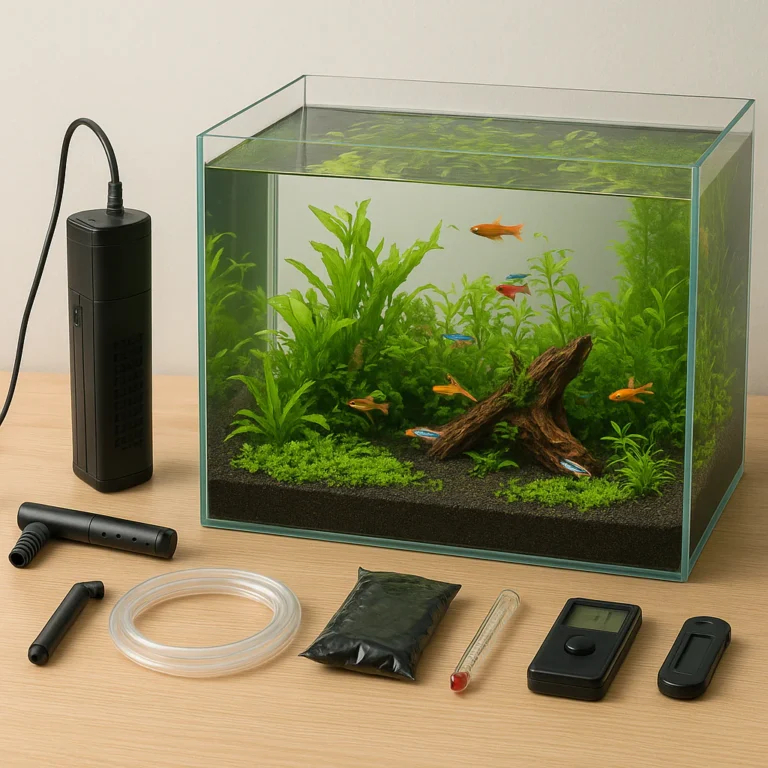
A reliable tropical setup generally needs:
- Heater sized for the aquarium and room temperature
- Independent thermometer
- Filter with biological media
- Water conditioner
- Test kit
- Gravel vacuum
- Algae scraper
- Aquarium lid
- Fish net
- Quarantine container
- Timer for lights
- Power strip with drip loops
Heater safety steps:
- Install the heater near water movement.
- Keep it fully submerged if the model requires it.
- Allow it to cool before removing it during a water change.
- Use a separate thermometer.
- Inspect for cracks, condensation, or malfunction.
- Consider a temperature controller for valuable or sensitive fish.
Browse our Aquarium Equipment category for equipment-focused guides.
Tropical Fish Compatibility and Community Tank Planning
Compatibility is not a colorful chart alone. It is a behavioral contract involving temperature, water chemistry, adult size, swimming zone, feeding speed, and territorial expectations.
Peaceful Community Fish Combinations
South American planted community
- Cardinal or neon tetras
- Corydoras
- Hatchetfish, with a secure lid
- Honey gourami or a peaceful dwarf cichlid
- Driftwood, leaf litter, and rooted plants
Southeast Asian community
- Harlequin rasboras
- Kuhli loaches
- Honey gouramis
- Small peaceful barbs
- Java fern, Cryptocoryne, moss, and floating plants
Hard-water livebearer community
- Guppies
- Platies
- Mollies, if the aquarium is large enough
- Bristlenose pleco
- Nerite snails
Keep an eye on reproductive output. A peaceful community can become overstocked without a single fish becoming aggressive.
Active community aquarium
- Zebra danios
- Cherry barbs
- Larger rasboras
- Corydoras
- A bristlenose pleco in a suitable tank
Use a long aquarium and avoid combining hyperactive species with timid, slow-feding fish.
Semi-Aggressive and Territorial Tropical Fish
Species may be peaceful most of the time but territorial during:
- Spawning
- Feeding
- Pair formation
- New fish introductions
- Rearangement of décor
- Limited-space conditions
Examples include:
- German blue rams
- Kribensis
- Angelfish
- Tiger barbs
- Flowerhorns
- Many African cichlids
- Some gouramis
Aquascaping can reduce conflict:
- Rearange décor before adding a new territorial fish.
- Create multiple caves or territories.
- Use plants and wood as sightline breaks.
- Add schooling fish in proper numbers.
- Avoid forcing incompatible species into a “peaceful” label.
Fish That Should Not Be Kept Together
Avoid combinations such as:
- Large angelfish with tiny ember tetras
- Tiger barbs with betas
- Oscars with small community fish
- Flowerhorns with peaceful schooling fish
- African mbuna with soft-water blackwater fish
- Clown loaches in ordinary nano or medium aquariums
- Hillstream loaches with warm, stagnant setups
- Large plecos with small, delicate aquariums
- Discus with fish requiring significantly cooler water
- Fin-nippers with long-finned guppies
Schooling, Shoaling, and Pairing Requirements
Schooling often describes coordinated group movement, while shoaling refers more broadly to fish staying together. In aquarium conversations, the terms are often used loosely.
| Fish | Practical group recommendation |
|---|---|
| Neon tetra | 6 minimum; 8–12 preferred |
| Cardinal tetra | 8+ |
| Ember tetra | 8–12 |
| Harlequin rasbora | 6–10 |
| Zebra danio | 6+ |
| Tiger barb | 8–10+ |
| Corydoras | 6+ of one species |
| Kuhli loach | 6+ |
| Rainbowfish | 6+ |
| Forktail blue-eye | 8–10+ |
| Whiptail catfish | Often 6+ for social comfort |
| Beta | Usually solitary, especially males |
If a fish looks nervous, hides constantly, or displays frantic darting, check group size before diagnosing a disease.
Bottom-Dwelling and Top-Dwelling Tank Mates
Layering the aquarium can work beautifully:
- Top: hatchetfish, killifish, surface gouramis
- Middle: tetras, rasboras, danios, rainbowfish
- Bottom: Corydoras, kuhli loaches, plecos
But vertical layering does not erase territorial overlap. A beta may claim the surface and upper-middle area; angelfish may patrol the entire water column; a kribensis pair may defend the bottom. Think in terms of territories, not just swimming levels.
Tropical Fish Food and Feeding Guide
A fish’s color, growth, immune function, and behavior are strongly influenced by nutrition. The best feeding plan combines variety, correct particle size, moderate portions, and observation.
Flakes, Pelets, Wafers, Frozen, and Live Foods
| Food type | Best suited to | Benefits | Drawbacks |
|---|---|---|---|
| Flakes | Surface and midwater community fish | Convenient, easy to portion | Can lose nutrients if poorly stored |
| Micro-pelets | Tetras, rasboras, small gouramis | Uniform size, less waste | Some fish need time to accept them |
| Sinking pellets | Corydoras, loaches, plecos | Reaches bottom feeders | Can be stolen by fast fish |
| Algae wafers | Plecos, otos, shrimp | Supports herbivorous grazers | Can pollute water if uneaten |
| Frozen foods | Most carnivorous and omnivorous fish | High palatability and variety | Requires freezer storage |
| Live foods | Fry, conditioning adults, picky species | Stimulates natural feeding | Disease and contamination risk |
| Gel foods | Mixed community diets | Customizable nutrition | More preparation required |
Real brands commonly used by aquarists include:
- Hikari tropical fish foods
- NorthFin community foods
- Repashy gel foods
- New Life Spectrum
- Fluval Bug Bites
👉 CHECK PRICE on:
- Hikari Micro Wafers and Tropical Pelets: Amazon | Hikari Official Website
- Fluval Bug Bites: Amazon | Fluval Official Website
- Repashy Community Plus: Amazon | Repashy Official Website
- NorthFin Community Formula: Amazon | NorthFin Official Website
Feeding Schedules by Fish Type
Small schooling fish
Feed small portions once or twice daily. Food should be consumed within approximately one to two minutes.
Bettas and gouramis
Feed small portions once or twice daily. Include high-quality pellets and occasional frozen foods such as daphnia or brine shrimp.
Corydoras and loaches
Feed after the main lights dim or switch off. Use sinking foods and observe whether bottom dwellers actually receive them.
Plecos and herbivores
Offer algae-based foods and vegetables, but verify species-specific nutrition. A pleco that eats algae wafers is not automatically a strict herbivore.
Fry
Feed tiny portions several times daily. Remove excess food promptly and use gentle filtration to avoid sucking in fry.
How to Prevent Overfeeding and Water Pollution
- Feed less than your first instinct suggests.
- Watch whether food reaches every zone.
- Remove uneaten food with a siphon.
- Store food sealed, cool, and dry.
- Rotate foods rather than relying on a single formula.
- Adjust portions during vacations, heat waves, or illness.
- Do not feed extra because fish “look hungry.” Many fish always look hungry.
Aquarium Maintenance Routine
A reliable maintenance routine is less dramatic than an emergency rescue—and vastly more pleasant.
Daily, Weekly, and Monthly Fish Tank Tasks
| Frequency | Tasks |
|---|---|
| Daily | Observe fish, check temperature, verify filter flow, remove obvious dead leaves |
| Every few days | Inspect feeding response, check surface agitation, look for unusual spots or behavior |
| Weekly | Test key water parameters, perform partial water change, clean glass, vacuum selected substrate |
| Every 2–4 weeks | Prune plants, rinse mechanical filter media in removed tank water, inspect equipment |
| Monthly | Check heater, airline tubing, seals, lighting timer, and stocking growth |
| As needed | Quarantine sick fish, adjust feeding, replace worn equipment |
Water Changes and Gravel Cleaning
A typical water change may be 20–30% weekly, but the correct schedule depends on:
- Stocking density
- Plant mass
- Feeding volume
- Nitrate accumulation
- Filter capacity
- Aquarium maturity
- Fish sensitivity
Step-by-step water change:
- Turn off heaters and equipment that may run dry.
- Match replacement water temperature as closely as practical.
- Add water conditioner according to the product label.
- Siphon debris from selected substrate areas.
- Avoid stripping every surface clean in one session.
- Refill slowly to prevent disturbing plants and décor.
- Restart equipment and verify flow.
- Check thermometer after the refill.
See our detailed guide on how often to clean your fish tank for a maintenance schedule built around fish health rather than cosmetic perfection.
Filter Maintenance Without Killing Beneficial Bacteria
Never rinse biological media under untreated tap water if chlorine or chloramine is present.
Instead:
- Save some removed aquarium water during a water change.
- Swish mechanical sponges gently in that water.
- Avoid replacing all biological media at once.
- Replace chemical media according to its purpose and manufacturer guidance.
- Check impellers and intake screens.
- Restore media in the correct order.
Filter maintenance mistake: replacing every cartridge because it looks dirty. Many cartridges contain valuable biological bacteria. Clean or replace media strategically.
Tropical Fish Diseases, Parasites, and Health Problems
Disease prevention begins with:
- Quarantine
- Stable water quality
- Proper nutrition
- Low stress
- Responsible stocking
- Observation
A fish that is breathing rapidly is not “just resting.” A fish with clamped fins is not “being shy” indefinitely. Behavior is data.
Ich, Fin Rot, Velvet, and Fungal Infections
Ich
Common signs:
- White spots resembling grains of salt
- Scratching against décor
- Clamped fins
- Rapid breathing
- Increased hiding
Ich treatment varies by product and temperature. Follow the medication label, remove activated carbon if instructed, and continue treatment for the full course.
Fin rot
Possible signs:
- Frayed fins
- Receding fin edges
- Redness
- Secondary infection
Improve water quality first. Medication may be necessary if the condition is advanced or bacterial infection is suspected.
Velvet
Possible signs:
- Fine gold or dusty coating
- Flashing
- Lethargy
- Clamped fins
- Rapid breathing
Velvet can progress quickly. Quarantine and prompt diagnosis matter.
Fungal infections
Often appear as cotton-like growths on damaged tissue or eggs. Address the original injury or water-quality problem while using an appropriate treatment.
The Merck Veterinary Manual fish disease resources are more reliable than diagnosing from a single social-media photograph.
Swim Bladder Problems and Dropsy
“Swim bladder disease” is often used as a catch-all phrase. Floating, sinking, or tilted swimming may result from:
- Constipation
- Injury
- Infection
- Buoyancy disorders
- Organ damage
- Poor water quality
Dropsy is a symptom of severe internal dysfunction, commonly associated with pineconing scales, swelling, and lethargy. Treatment success is limited once advanced.
First response:
- Test ammonia and nitrite.
- Perform an appropriate water change.
- Move the fish to quarantine if needed.
- Reduce stress and improve oxygenation.
- Seek veterinary guidance for valuable or unusual fish.
Quarantine Procedures for New Fish
A practical quarantine routine:
- Set up a separate tank with heater, sponge filter, lid, and hiding place.
- Match temperature and gradually acclimate the fish.
- Observe appetite, feces, breathing, and skin condition.
- Maintain quarantine for two to four weeks.
- Treat only when symptoms or a clear risk justifies treatment.
- Use separate nets and siphon equipment.
- Never pour store water into the display aquarium.
- Transfer fish with a net or specimen container.
When and How to Use Aquarium Medications
Avoid throwing multiple medications into the display tank “just in case.” It can:
- Harm sensitive fish or invertebrates
- Damage biological filtration
- Complicate diagnosis
- Make it impossible to know what worked
Read labels carefully, remove activated carbon when directed, increase aeration during treatment, and verify invertebrate safety.
How to Choose Healthy Tropical Fish
The healthiest-looking aquarium-store fish is not always the most colorful one. Select fish that are:
- Alert
- Upright
- Actively feeding
- Free of obvious lesions
- Breathing normally
- Not isolated without explanation
- Showing intact fins and clear eyes
- Swimming naturally for the species
Signs of a Healthy Fish at the Aquarium Store
| Healthy sign | Warning sign |
|---|---|
| Responsive to movement | Unresponsive or lying on the bottom |
| Smooth body and intact scales | Ulcers, raised scales, or sores |
| Normal breathing | Rapid gill movement |
| Good appetite | Refuses food repeatedly |
| Appropriate body shape | Severe emaciation or bloating |
| Clear eyes | Cloudy or protruding eyes |
| Active group behavior | Constant hiding or erratic swimming |
| Clean fins | Severe fraying or red streaks |
Do not buy a fish from a tank containing several visibly sick fish unless you are prepared for quarantine and possible loss.
Wild-Caught Versus Captive-Bred Fish
Captive-bred advantages
- Often adapted to aquarium foods
- May tolerate domestic water better
- Reduces pressure on wild populations
- More predictable availability
- Useful for conservation when responsibly managed
Wild-caught advantages
- Preserves natural coloration and behavior
- Important for genetic diversity
- May be necessary for rare species programs
- Can support local collectors when responsibly sourced
Wild-caught drawbacks
- Parasites are more likely
- Aclimation may be harder
- Feeding can be challenging
- Ethical and conservation concerns vary by species and collection area
Look for transparent sourcing and avoid species that cannot be responsibly housed in your aquarium.
Responsible Fishkeeping and Ethical Sourcing
Do not purchase:
- Fish known to outgrow your aquarium
- Illegal or restricted species
- Dyed or artificially tattooed fish
- Severely deformed fish bred solely for novelty
- Fish that require groups you cannot accommodate
- Species that depend on live foods you cannot provide
The Convention on International Trade in Endangered Species of Wild Fauna and Flora and the IUCN Red List are useful references for conservation status and trade concerns.
Tropical Fish Breding and Fry Care
Breding tropical fish can be rewarding, but it can also turn a calm aquarium into a tiny maternity ward with territorial parents, hungry tank mates, and more fry than you expected by breakfast.
Livebearers: Guppies, Platies, Mollies, and Swordtails
Livebearers give birth to free-swimming fry rather than laying external eggs.
To improve fry survival:
- Use dense plants such as Java moss or water sprite.
- Provide floating cover.
- Separate fry if necessary.
- Feed powdered or finely crushed foods.
- Perform small, frequent water changes.
- Control adult population growth.
A female livebearer may store sperm, so separating males and females does not always stop reproduction immediately.
Egg-Laying Tropical Fish
Egg-laying species may:
- Scatter eggs among plants
- Deposit eggs on leaves
- Guard caves
- Build bubble nests
- Mouthbrod eggs
- Spawn on flat surfaces
Examples include:
- Bettas
- Gouramis
- Tetras
- Barbs
- Corydoras
- Rams
- Angelfish
- Kribensis
- Killifish
Breding Community Fish Without Losing the Fry
The community aquarium is usually a poor nursery because adult fish eat eggs and fry.
Step-by-step breeding plan:
- Identify whether the species is an egg scatter, cave spawner, nest builder, or livebearer.
- Prepare a breeding tank.
- Add species-appropriate spawning material.
- Condition adults with varied high-quality food.
- Remove adults if they are likely to eat eggs.
- Maintain gentle filtration.
- Feed fry appropriately sized foods.
- Perform small, frequent water changes.
- Grade or separate fast-growing juveniles.
- Plan where the juveniles will go.
Corydoras breeding can be triggered by cooler, oxygen-rich water changes, while betas may require a floating bubble-nest structure and carefully managed male behavior. Species-specific research is essential.
Best Tropical Fish by Experience Level
Easy Tropical Fish for Beginners
Our favorite beginner-friendly choices include:
- Harlequin rasboras
- Zebra danios
- Cherry barbs
- Platies
- Guppies
- Endler’s livebearers
- Corydoras
- Kuhli loaches
- Honey gouramis
- Bristlenose plecos, in appropriately sized tanks
“Easy” still means:
- Cycled aquarium
- Proper heater
- Stable water
- Correct feeding
- Regular maintenance
- Compatible stocking
Intermediate Aquarium Fish
Consider these after gaining experience:
- Pearl gouramis
- Bolivian rams
- Kribensis
- Rainbowfish
- Otocinclus
- Tiger barbs
- Killifish
- Angelfish
- Disciplined livebearer breeding projects
Advanced Tropical Fish for Experienced Aquarists
These require more specialized care:
- German blue rams
- Discus
- Wild-caught fish
- African cichlid communities
- Flowerhorns
- Large predatory fish
- Hillstream loaches in high-flow systems
- Difficult-to-feed specialist species
- Large groups of fish with complex social structures
Best Tropical Fish by Aquarium Style
Colorful Tropical Fish
Top visual choices include:
- Cardinal tetras
- Ember tetras
- Fancy guppies
- Endler’s livebearers
- Honey gouramis
- German blue rams
- Rainbowfish
- Killifish
- Discus
- Cherry barbs
Color is influenced by:
- Genetics
- Diet
- Stress
- Background color
- Lighting spectrum
- Social interaction
- Water quality
A stressed fish may appear dull no matter how excellent its genetic color potential.
Small Tropical Fish
Excellent small-fish options include:
- Ember tetras
- Neon tetras
- Chili rasboras
- Endler’s livebearers
- Pygmy Corydoras
- Celestial pearl danios
- Honey gouramis
- Small killifish
Remember: small fish can still require large groups, open swimming space, or specialized chemistry.
Peaceful Tropical Fish
Popular peaceful choices include:
- Corydoras
- Harlequin rasboras
- Neon tetras
- Cherry barbs
- Honey gouramis
- Kuhli loaches
- Platies
- Otocinclus
- Many rainbowfish
“Peaceful” does not mean “compatible with everything.” A peaceful fish may still be eaten, outcompeted, or stressed by active tank mates.
Active Tropical Fish
Choose:
- Zebra danios
- Rainbowfish
- Tiger barbs
- Cherry barbs
- Swordtails
- Larger rasboras
- Some livebearers
Use longer aquariums and avoid placing timid fish in their wake.
Tropical Fish for Heavily Planted Tanks
Strong choices include:
- Tetras
- Rasboras
- Honey gouramis
- Bettas
- Corydoras
- Kuhli loaches
- German blue rams, in mature systems
- Otocinclus, only in mature tanks
- Small rainbowfish
Plants reduce stress, but dense growth can obstruct maintenance and lower nighttime oxygen if poorly managed. Trim intentionally.
Tropical Fish for Biotope Aquariums
Amazon-inspired biotope
- Cardinal tetras
- Corydoras
- Pencilfish
- Apistograma
- Angelfish, in a larger aquarium
- Amazon swords
- Anubias
- Driftwood and leaf litter
Southeast Asian blackwater biotope
- Beta species
- Rasboras
- Kuhli loaches
- Gouramis
- Cryptocoryne
- Java fern
- Botanicals and roots
African river biotope
- Kribensis
- African tetras
- Butterflyfish, for advanced keepers
- Anubias
- Root structures
- Gentle surface cover
Rift Lake cichlid aquarium
- Lake Malawi or Tanganyika species selected by region
- Rockwork or shells
- Strong filtration
- Alkaline, mineral-rich water
- Species-specific stocking
Do not mix unrelated biotope concepts merely because the colors look good together. A natural-looking aquarium should also make ecological sense.
Common Tropical Fishkeeping Mistakes
❌ Buying fish before cycling the aquarium
❌ Choosing fish based on juvenile size
❌ Keeping schooling species in pairs
❌ Overfeeding
❌ Treating the aquarium as self-cleaning because it is planted
❌ Replacing all filter media at once
❌ Adding large plecos to small tanks
❌ Keeping male betas together
❌ Combining African cichlids with soft-water tetras
❌ Ignoring the need for a lid
❌ Using sharp gravel with Corydoras
❌ Buying fish from a visibly diseased store tank
❌ Treating pH instead of choosing compatible species
❌ Assuming “algae eater” means no additional food
❌ Trusting the phrase “community fish” without checking adult size
❌ Adding new fish without quarantine
The most expensive mistake is often not the fish itself. It is the entire setup built around an incompatible animal.
Smart Aquarium Tips for Better Fish Behavior
Use environmental enrichment
Add:
- Plants
- Wood
- Caves
- Floating cover
- Open swimming lanes
- Varied textures
- Gentle current zones
- Dimer areas
Feed fish where they naturally forage
- Surface feeders: floating or slowly sinking foods
- Midwater fish: micro-pelets and flakes
- Bottom dwellers: sinking wafers and targeted feeding
- Nocturnal species: feed after lights dim
- Grazers: provide biofilm, vegetables, or algae-based foods
Rearange décor before adding territorial fish
This resets established territories and can reduce immediate aggression. It is especially useful with:
- Cichlids
- Gouramis
- Bettas
- Kribensis
- Flowerhorns
Use lighting to encourage natural behavior
A sudden blast of bright light can startle fish. Try:
- Turning on room lights first.
- Adding floating plants for shade.
- Using a gradual lighting schedule if available.
- Maintaining a consistent day-night cycle.
Watch the fish, not just the equipment
Healthy behavior may include:
- Active exploration
- Species-appropriate schooling
- Regular feeding
- Normal resting periods
- Courtship or territorial displays without persistent injury
Warning behavior includes:
- Constant hiding
- Gasping
- Repeated flashing
- Isolation from the group
- Clamped fins
- Frantic glass surfing
- Refusal to feed
- Persistent chasing
The final piece of the puzzle is now clear: the “best” tropical fish list is less about collecting the most colorful species and more about composing a stable, compatible ecosystem. Next, we can tie those recommendations together with a practical decision path.
Conclusion: Choosing the Best Tropical Fish for Your Aquarium

The best tropical fish species for aquariums are the ones that match your tank size, water chemistry, maintenance routine, experience, and long-term commitment.
For most new community aquariums, our confident starting recommendations are:
- Harlequin rasboras for hardy, peaceful schooling behavior
- Neon or ember tetras for planted-tank color
- Cherry barbs for activity without the usual tiger-barb drama
- Corydoras for peaceful bottom-level personality
- Honey gouramis as gentle centerpiece fish
- Guppies, platies, or Endler’s livebearers for color and easy breeding
- Kuhli loaches for nocturnal movement in planted layouts
For experienced aquarists, consider:
- German blue rams
- Angelfish
- Discus
- Rainbowfish
- Killifish
- African cichlid communities
- Carefully planned species aquariums
Avoid buying fish simply because they are beautiful, inexpensive, or tiny at the store. Adult size, social needs, aggression, and habitat requirements always win the argument. That juvenile Oscar, clown loach, or pleco is not a loophole in aquarium dimensions.
The incomplete story we began with has its answer: your aquarium becomes a symphony when every fish has the right “instrument”—the correct swimming space, group, diet, shelter, water, and tank mates. Choose the composition before you buy the performers. 🎶🐟
Recommended Links for Tropical Fishkeepers
Internal Aquarium Music™ guides
- Aquarium Setup
- Fish Care and Species Profiles
- Fish and Aquatic Life
- Aquarium Equipment
- Aquascaping and Aquatic Plants
- How Often Should You Clean Your Fish Tank? 🐠 (2026)
Recommended aquarium equipment
- API Freshwater Master Test Kit: Amazon | API Official Website
- Seachem Tidal Filter: Amazon | Seachem Official Website
- Fluval AquaClear Filter: Amazon | Fluval Official Website
- EHEIM Classic Canister Filter: Amazon | EHEIM Official Website
- Aqueon Adjustable Aquarium Heater: Amazon | Aqueon Official Website
- Fluval Plant 3.0 LED: Amazon | Fluval Official Website
- Hikari Tropical Fish Food: Amazon | Hikari Official Website
- Repashy Community Plus: Amazon | Repashy Official Website
- Aquarium Co-Op Sponge Filters: Aquarium Co-Op
- Seachem Prime Water Conditioner: Amazon | Seachem Official Website
Recommended tropical fishkeeping books
- Freshwater Aquariums for Dummies on Amazon
- The Complete Aquarium Guide by Jeremy Gay on Amazon
- Ecology of the Planted Aquarium by Diana Walstad on Amazon
- The 101 Best Aquarium Plants by Kevin Wilson on Amazon
FAQ

Can tropical fish species thrive in freshwater or saltwater aquariums?
Most fish discussed in this guide are tropical freshwater species. “Tropical” refers primarily to warm climate and water temperature; it does not mean saltwater.
Some livebearers, including certain mollies and guppies, can tolerate brackish or marine conditions after careful acclimation. That does not mean every population, strain, or community setup should be converted to saltwater.
Examples of freshwater tropical fish include:
- Neon tetras
- Corydoras
- Angelfish
- Discus
- Bettas
- Gouramis
- Rasboras
- Most plecos
Marine tropical fish require:
- Marine salt mix
- Specific salinity
- Reef or fish-only filtration
- Different calcium and alkalinity management
- Marine-compatible livestock and equipment
Never add aquarium salt or marine salt casually to a freshwater community tank.
Read more about “15 Fish-Friendly Aquarium Plants Your Fish Will Love 🐠”
What are the care requirements for popular tropical fish species?
Core requirements include:
- A fully cycled aquarium
- Species-appropriate temperature
- Stable pH and hardness
- Adequate filtration
- Correct group size
- Appropriate food
- Compatible tank mates
- Regular water changes
- Quarantine for new arrivals
Examples:
- Neon tetras: Groups, peaceful tank mates, stable warm water, planted cover
- Bettas: Warm water, gentle flow, surface access, individual temperament assessment
- Corydoras: Groups, smooth substrate, sinking food, clean oxygenated water
- Guppies: Harder water, male-to-female ratio, population control
- Discus: High temperature, excellent maintenance, large group aquarium
- Angelfish: Vertical space, adult-size planning, larger tank mates
- Otocinclus: Mature planted aquarium and supplemental food
Care requirements are species-specific, which is why a generic “tropical fish” setup often disappoints.
Read more about “Fish Compatibility and Community: 13 Expert Tips for Peaceful Tanks (2026) 🐟”
How do tropical fish species affect the aquarium ecosystem?
Every fish affects the aquarium through:
- Waste production
- Oxygen consumption
- Feeding competition
- Territorial behavior
- Plant interaction
- Nutrient cycling
- Disease risk
- Bioload
Schooling fish may create constant movement and consume small foods throughout the water column. Bottom dwellers disturb substrate and depend on food delivery. Large cichlids reshape décor and produce heavy waste. Algae grazers consume biofilm but still contribute to nitrate.
A community aquarium is an ecosystem, not a decorative container. Stocking must account for the combined effects of every inhabitant.
Read more about “How Often Should You Clean Your Fish Tank? 🐠 (2026)”
Which tropical fish species are compatible with each other?
Good combinations often involve:
- Similar adult size
- Similar temperature requirements
- Similar water chemistry
- Peaceful or compatible temperaments
- Different but overlapping swimming zones
- Appropriate group sizes
Examples:
- Harlequin rasboras with Corydoras and honey gouramis
- Neon tetras with peaceful Corydoras
- Platies with other hard-water livebearers
- Cherry barbs with Corydoras in a spacious aquarium
- Kuhli loaches with rasboras and gouramis
Avoid pairing:
- Predators with small fish
- Fin-nippers with long-finned fish
- Aggressive cichlids with timid community species
- Warm-water discus with cool-water fish
- African rift-lake cichlids with soft-water tetras
Read more about “🌊 25 Secrets to Mastering Saltwater Aquarium Fish in 2026”
What are the most colorful tropical fish species for home aquariums?
Highly colorful freshwater choices include:
- Fancy guppies
- Endler’s livebearers
- Cardinal tetras
- Neon tetras
- Ember tetras
- German blue rams
- Discus
- Killifish
- Rainbowfish
- Cherry barbs
- Honey gouramis
- Beta splendens
Color is best displayed with appropriate lighting, a dark or natural background, low stress, and a quality diet. A brilliant fish in poor water may fade quickly.
Read more about “🏆 Top 10 Best Fish for a Home Aquarium (2026)”
How do I choose the right tropical fish species for a community tank?
Use this sequence:
- Measure the aquarium’s actual volume and footprint.
- Test your source water.
- Decide whether you want peaceful, active, planted, biotope, or species-focused fish.
- Choose a primary schooling group.
- Add one bottom-dwelling group if the tank has room.
- Select one centerpiece only if adult territory allows.
- Check temperature and chemistry overlap.
- Confirm every fish’s adult size.
- Plan quarantine.
- Add fish gradually while monitoring ammonia and nitrite.
Start with the aquarium’s limitations, not the fish store’s most colorful display.
Read more about “15 Eco-Friendly Aquarium Options for 2026 🌿🐠”
What are the best tropical fish species for beginner aquariums?
Strong beginner choices include:
- Harlequin rasboras
- Zebra danios
- Cherry barbs
- Platies
- Guppies
- Endler’s livebearers
- Corydoras
- Kuhli loaches
- Honey gouramis
Bettas can also be excellent beginner fish when kept in a properly heated, filtered aquarium rather than a cup.
Read more about “15 Best Fish Tank and Aquarium Forums and Communities to Join (2026) 🐠”
Which tropical fish species can live peacefully together in a community aquarium?
Common peaceful combinations include:
- Neon tetras, Corydoras, and honey gouramis
- Harlequin rasboras, kuhli loaches, and peaceful gouramis
- Cherry barbs, Corydoras, and bristlenose plecos
- Platies, guppies, and snails in moderately hard water
- Ember tetras, pygmy Corydoras, and peaceful shrimp in mature planted tanks
Always check individual temperament. Fish are animals, not software packages with identical behavior.
What tropical fish species are ideal for small home aquariums?
For smaller aquariums, consider:
- A single beta
- Endler’s livebearers
- Ember tetras in a mature planted setup
- Chili rasboras for experienced aquarists
- Pygmy Corydoras in an appropriate group
- Neocaridina shrimp and nerite snails
Avoid large or highly active fish. A small aquarium has less buffering capacity and less room for territorial separation.
Read more about “🌊 7 Underwater Aquarium Design Styles to Transform Your Tank (2026)”
How many tropical fish species can be kept in the same aquarium?
There is no safe universal species count. One species in an overstocked tank can be worse than four species in a spacious, well-filtered aquarium.
Assess:
- Adult size
- Group requirements
- Bioload
- Swimming behavior
- Territory
- Filtration
- Water changes
- Feeding competition
- Plant density
A 20-gallon aquarium might support one carefully planned community, but not every fish listed in a “20-gallon stocking idea” article.
Read more about “Your First Fish”
What water temperature do tropical fish species need to thrive?
Many popular tropical freshwater fish thrive around 75–80°F (24–27°C), but requirements vary:
- Neon tetras: approximately 68–79°F
- Ember tetras: approximately 75–82°F
- Bettas: approximately 76–82°F
- Corydoras: species-dependent
- Kuhli loaches: approximately 75–86°F
- German blue rams: approximately 78–85°F
- Discus: commonly 82–86°F
- Hillstream loaches: often cooler, approximately 64–77°F
Use a heater and independent thermometer. Avoid choosing fish with incompatible temperature ranges.
Read more about “🌿 Top 15 Best Plants for Freshwater & Saltwater Tanks (2026)”
Which tropical fish species are the most colorful for a freshwater aquarium?
For maximum color in freshwater:
- Fancy guppies offer the widest variety of patterns.
- Cardinal tetras provide strong red-and-blue contrast.
- German blue rams add iridescent blue and yellow.
- Rainbowfish develop metallic coloration in groups.
- Discus offer spectacular large-bodied patterns.
- Killifish bring intense color to the surface.
- Bettas provide exceptional finnage and color morphs.
Colorful does not automatically mean easy. German blue rams and discus are much more demanding than guppies or cherry barbs.
Read more about “15 Best Fish for a Beginner’s Aquarium in 2026 🐠”
What tropical fish species are easiest to breed in a home aquarium?
The easiest commonly bred tropical fish include:
- Guppies
- Endler’s livebearers
- Platies
- Mollies
- Swordtails
- Kribensis
- Bettas, with a dedicated breeding setup
- Zebra danios
- Corydoras, with conditioning and suitable spawning conditions
Livebearers are easiest for producing fry, but their population can grow rapidly. Egg layers may require more careful preparation, egg protection, and fry feeding.
Read more about “🎨 Custom Aquarium Design: Your 2026 Guide to Living Art”
Are African cichlids suitable for a peaceful tropical community aquarium?
Usually not in a typical mixed community aquarium. African rift-lake cichlids often require:
- Alkaline, mineral-rich water
- Rockwork or shells
- Carefully chosen species combinations
- Territorial planning
- Strong filtration
- Appropriate stocking density
They are best kept in region-specific or species-focused aquariums rather than combined with neon tetras, discus, or soft-water South American fish.
Read more about “🐠 The Ultimate Fish Tank Size Guide (2026): Stop Guessing, Start Thriving”
Can tropical fish live with shrimp and snails?
Some can, but compatibility depends on mouth size and hunting behavior.
Usually safer choices include:
- Small rasboras
- Ember tetras
- Otocinclus
- Corydoras
- Honey gouramis, with caution
- Small livebearers, though they may eat fry
Riskier fish include:
- Angelfish
- Bettas with individual hunting behavior
- Larger gouramis
- Cichlids
- Barbs
- Predatory fish
Nerite snails are often useful in planted community aquariums, but they still need adequate food and stable mineral levels.
Read more about “🦐 Can I Keep Shrimp & Snails in My Fish Tank? (2026)”
How long should tropical fish be quarantined?
A practical quarantine period is two to four weeks, with longer observation for valuable, wild-caught, or visibly stressed fish.
During quarantine:
- Watch appetite and breathing.
- Check feces and body condition.
- Inspect fins and skin.
- Test water.
- Treat only when justified.
- Keep equipment separate.
The longer the fish remains symptom-free and eating well, the lower the chance of introducing a problem to the display aquarium.
Reference Links
Scientific and animal-health references
- FishBase: Global Fish Information System
- Merck Veterinary Manual: Fish
- U.S. Environmental Protection Agency: Amonia
- IUCN Red List of Threatened Species
- CITES: Convention on International Trade in Endangered Species
- Smithsonian’s National Zoo: Fish
- University of Wisconsin Zebrafish Information Network
- Encyclopaedia Britannica: Tropical Rainforest Ecosystems
Aquarium brand references
- API Official Website
- Seachem Official Website
- Fluval Official Website
- EHEIM Official Website
- Aqueon Official Website
- Hikari Official Website
- Repashy Official Website
- NorthFin Official Website
- JBL Aquatics Water Analysis
- Aquarium Co-Op
Related tropical fish species resources