Support our educational content for free when you purchase through links on our site. Learn more
🐟 Freshwater Aquarium Fish Breding: 10 Secrets to Raise Fry Like a Pro (2026)

Ever watched a tank full of adult fish and wondered, “Where are the babies?” You aren’t alone. Many hobbyists spend years maintaining pristine water and feeding the best foods, only to be met with silence when it comes to reproduction. But here’s the secret: breeding isn’t magic; it’s a symphony of specific triggers waiting to be conducted. At Aquarium Music™, we’ve seen everything from accidental “fry explosions” with Endlers to the meticulous dance of breeding rare Apistograma cichlids. The difference between failure and a tank teming with life often comes down to one overlooked detail.
In this comprehensive guide, we’re pulling back the curtain on freshwater aquarium fish breeding. We’ll walk you through the exact water parameters that trigger spawning, the nutritional “superfoods” that condition your breeders, and the critical mistake 90% of beginners make that leads to a tank full of empty shells. Whether you want to turn your hobby into a profitable side hustle or simply witness the miracle of new life, we’ve got the roadmap. By the end of this article, you’ll know exactly how to set up a breeding tank, distinguish between egg layers and livebearers, and even how to price your fry for the local fish store. Ready to turn your tank into a nursery? Let’s dive in.
Key Takeaways
- Trigger the Spawning: Success hinges on mimicking natural environmental cues, such as large water changes, temperature shifts, and soft water chemistry, rather than just waiting for fish to “decide” to breed.
- Nutrition is Non-Negotiable: You cannot breed fish on flake food alone; a high-protein diet of live or frozen foods like brine shrimp and bloodworms is essential to condition breeders and increase egg viability.
- Protect the Offspring: The biggest killer of fry is cannibalism; always use sponge filters, dense vegetation, or separate rearing tanks to ensure your babies survive to adulthood.
- Start with the Easiest Species: If you are new to breeding, begin with prolific and forgiving species like Endler’s Livebearers, Guppies, or Bristlenose Plecos before attempting complex egg-scatters.
- Profit Requires Strategy: While breeding can offset hobby costs, turning it into a business requires calculating operational costs, understanding market demand, and maintaining consistent quality to sell to local fish stores.
Table of Contents
- ⚡️ Quick Tips and Facts
- 📜 A Brief History of Freshwater Aquarium Fish Breding
- 🧬 Mastering the Art of Freshwater Aquarium Fish Breding: A Step-by-Step Guide
- 1. Selecting the Perfect Breding Stock
- 2. Setting Up the Ideal Breding Tank Environment
- 3. Triggering the Spawning Process with Water Parameters
- 4. The Art of Conditioning: Diet and Nutrition for Breeders
- 5. Recognizing Signs of Readiness and Courtship Rituals
- 6. Managing the Spawning Event: Egg Layers vs. Livebearers
- 7. Incubation Secrets: Temperature, Oxygen, and Light Control
- 8. Raising Fry: From First Feed to Juvenile Growth
- 9. Common Breding Mistakes and How to Avoid Them
- 🐟 Top 10 Easiest Freshwater Fish to Breed for Beginners
- 💰 Turning Hobby into Hustle: The Economics of Breding Aquarium Fish
- Is Breding Fish Profitable? Analyzing the Real Costs
- Which Species Offer the Best Return on Investment?
- Calculating Operational Costs: Food, Electricity, and Equipment
- Pricing Your Fish: How to Value Your Fry and Juveniles
- 🏪 From Tank to Trade: Selling Your Breding Success
- How to Approach Local Fish Stores (LFS) and Pet Shops
- Selling Online: Marketplaces, Forums, and Social Media Strategies
- Navigating Shipping Regulations and Safe Transport Methods
- 🚨 Overpopulation Solutions: What to Do When Your Tanks Overflow
- 🛠️ Essential Gear and Supplies for the Aspiring Breder
- 🧪 Water Chemistry Deep Dive: pH, Hardness, and Temperature for Breding
- 🦠 Disease Prevention and Quarantine Protocols for Breding Stock
- 📚 Recommended Links
- ❓ FAQ: Your Burning Questions About Freshwater Fish Breding Answered
- 📖 Reference Links
- 🏁 Conclusion
⚡️ Quick Tips and Facts
Welcome to the Aquarium Music™ family! Before we dive into the deep end of the breeding pool, let’s hit the high notes. Breding freshwater fish isn’t just about slapping two fish together and hoping for the best; it’s a symphony of water chemistry, nutrition, and timing.
Here are the golden rules we’ve learned after years of watching fry dart around our tanks:
- ✅ The “Don’t Eat Your Kids” Rule: The number one cause of breeding failure is cannibalism. Livebearers (like Guppies) and egg scatters (like Danios) will happily munch on their own offspring if given the chance. You must provide hiding spots like Java moss, spawning mops, or a separate rearing tank.
- ✅ Water is Life: You can have the healthiest fish in the world, but if your water parameters are off, breeding won’t happen. Soft, acidic water often triggers egg-layers, while harder water suits livebearers. Consistency is key!
- ✅ Feed to Breed: You cannot expect fish to spawn on flake food alone. High-protein live or frozen foods (like brine shrimp, bloodworms, and daphnia) are the fuel that triggers the reproductive system.
- ✅ Patience is a Virtue: Some fish breed in 24 hours; others take months to pair up. Don’t rush the process.
- ❌ The “More is Better” Myth: Overcrowding your breeding tank stresses the fish and lowers water quality, leading to failed spawns. Quality over quantity always wins.
Did you know? The Endler’s Livebearer is so prolific that many hobbyists accidentally end up with a tank full of them without even trying! As one expert noted, “I’ve just got all these tanks in the fish room just full of Endlers accidentally… they’re just breeding.”
📜 A Brief History of Freshwater Aquarium Fish Breding

While we often think of aquariums as a modern hobby, the art of freshwater fish breeding has roots stretching back centuries. The ancient Chinese were the first to selectively breed Goldfish (Carassius auratus) over 1,0 years ago, transforming a dull grey carp into the vibrant, fancy varieties we adore today. They understood the basics of selective breeding long before the science of genetics was formalized.
Fast forward to the 19th century, and the European hobby exploded. The discovery of the Siamese Fighting Fish (Betta splendens) in Southeast Asia led to intense breeding programs in Thailand and France, where color and fin shape became the obsession. By the 1920s and 30s, the Guppy (Poecilia reticulata) was being exported from South America to Europe, sparking a craze that turned the hobby into a global phenomenon.
Today, aquarium fish breeding has evolved from simple color selection to complex genetic manipulation, creating strains like the Koi Beta, Rasbora heteromorpha, and the stunning Neon Tetra variations. We stand on the shoulders of giants, using their foundational knowledge to create new symphonies in our own tanks.
🧬 Mastering the Art of Freshwater Aquarium Fish Breding: A Step-by-Step Guide
So, you’re ready to become a fish breder? Excellent! But where do you start? It’s not magic; it’s science. Let’s break down the process into manageable steps.
1. Selecting the Perfect Breding Stock
The foundation of any successful breeding program is genetics. You don’t want to breed two fish that look sick or have deformities; you want the best of the best.
- Health Check: Look for fish with bright colors, active swimming, and clear eyes. Avoid fish with clamped fins, white spots, or bloated bellies (unless it’s a female ready to spawn!).
- Genetic Diversity: Avoid inbreding. If you buy a pair, try to source them from different breeders to prevent genetic defects.
- Sexual Dimorphism: You need to know your males from your females!
Guppies: Males are smaller, colorful, and have a gonopodium (modified anal fin). Females are larger, plainer, and have a gravid spot (dark area near the vent).
Bettas: Males have longer fins and vibrant colors; females have shorter fins and a white “egg spot” on their belly.
2. Setting Up the Ideal Breding Tank Environment
A breeding tank doesn’t need to be huge, but it needs to be perfect.
- Tank Size: For most small species, a 10 to 20-gallon tank is sufficient.
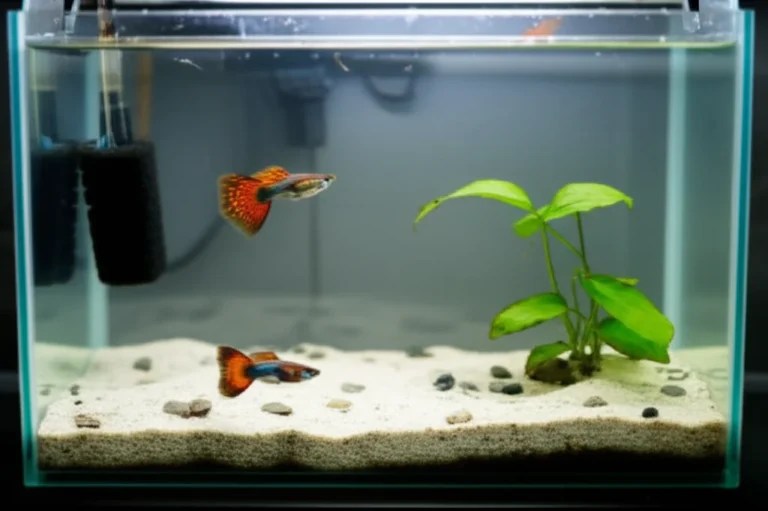
- Filtration: Use a sponge filter. It provides gentle filtration and a safe haven for fry to hide in the sponge pores.
- Substrate: Bare bottom is often best for egg-scatters to prevent eggs from getting lost or eaten. For livebearers, a thin layer of sand or gravel works.
- Decor: Add Java moss, floating plants (like Hornwort), or spawning mops. These provide cover for fry and mimic natural spawning grounds.
Pro Tip: Before adding fish, cycle your tank! A cycled tank ensures beneficial bacteria are present to handle the waste load of breeding fish. Check out our guide on Aquarium Setup for more details.
3. Triggering the Spawning Process with Water Parameters
Fish often need a “nudge” to start breeding. In the wild, this is triggered by rainy seasons or temperature shifts.
- Water Changes: A large water change (30-50%) with slightly cooler, soft water can mimic the rainy season and trigger spawning in many species like Tetras and Cichlids.
- Temperature: Slightly raising the temperature by 2-3°F (1-2°C) can speed up metabolism and trigger breeding behavior.
- pH and Hardness: Research your specific species. Discus need soft, acidic water, while Livebearers prefer harder, alkaline water.
4. The Art of Conditioning: Diet and Nutrition for Breeders
You can’t expect a marathon runner to run on junk food. Conditioning is the process of feeding your breeders high-quality food for 2-4 weeks before attempting to spawn.
- Live Foods: Baby brine shrimp, daphnia, and microworms are excellent for stimulating egg production.
- Frozen Foods: High-quality frozen bloodworms, brine shrimp, and mysis shrimp are great alternatives.
- Variety: Rotate foods to ensure a balanced diet.
5. Recognizing Signs of Readiness and Courtship Rituals
How do you know they are ready? Watch the behavior!
- Color Intensification: Males often become brighter.
- Chasing: Males may chase females, sometimes aggressively.
- Nest Building: Some species, like Bettas and Bristlenose Plecos, will build nests or clean caves.
- Distended Bellies: Females will look “square” or very round with eggs.
6. Managing the Spawning Event: Egg Layers vs. Livebearers
This is where the paths diverge.
- Egg Layers (Oviparous): Fish like Tetras, Angelfish, and Cichlids lay eggs.
Strategy: Remove the parents after spawning to prevent them from eating the eggs. Use a mesh basket or a separate tank for the eggs. - Livebearers (Viviparous): Fish like Guppies, Platies, and Swordtails give birth to free-swimming fry.
Strategy: Remove the mother to a separate tank just before birth, or provide dense vegetation in the main tank for the fry to hide.
7. Incubation Secrets: Temperature, Oxygen, and Light Control
Once the eggs are laid, the real work begins.
- Temperature: Keep it stable. Fluctuations can kill the embryos.
- Oxygen: Ensure good water movement but avoid strong currents that might damage the eggs.
- Light: Keep the tank dim. Bright light can promote algae growth and stress the developing embryos.
8. Raising Fry: From First Feed to Juvenile Growth
The most critical stage! Fry are tiny and fragile.
- First Feed: Infusoria or liquid fry food for the smallest fry. As they grow, switch to baby brine shrimp and crushed high-quality flakes.
- Water Quality: Perform small, frequent water changes (10-15% daily) to remove waste and keep water pristine.
- Growth Stages: Monitor their growth. Separate larger fry from smaller ones to prevent cannibalism.
9. Common Breding Mistakes and How to Avoid Them
- Mistake: Overfeeding. Result: Poor water quality and dead fry. Fix: Feed small amounts multiple times a day.
- Mistake: Ignoring water parameters. Result: No spawning or dead eggs. Fix: Test water regularly.
- Mistake: Removing parents too late. Result: Eaten eggs/fry. Fix: Know your species’ behavior and act fast.
🐟 Top 10 Easiest Freshwater Fish to Breed for Beginners
Ready to pick your first species? Here are the top 10 fish that are practically begging to be bred. We’ve ranked them by ease of breeding and availability.
| Rank | Species | Type | Difficulty | Key Requirement |
|---|---|---|---|---|
| 1 | Endler’s Livebearer | Livebearer | ⭐ (Very Easy) | Dense plants for fry |
| 2 | Guppy | Livebearer | ⭐ (Very Easy) | Separate female for birth |
| 3 | Platy | Livebearer | ⭐ (Very Easy) | Stable water temp |
| 4 | Swordtail | Livebearer | ⭐ (Very Easy) | Plenty of hiding spots |
| 5 | Bristlenose Pleco | Egg Layer | ⭐ (Easy) | Spawning cave |
| 6 | Neon Tetra | Egg Layer | ⭐ (Easy) | Soft, acidic water |
| 7 | Cherry Barb | Egg Layer | ⭐ (Easy) | Dense vegetation |
| 8 | Corydoras Catfish | Egg Layer | ⭐ (Easy) | Cool water change |
| 9 | Molly | Livebearer | ⭐ (Easy) | Harder water |
| 10 | Angelfish | Egg Layer | ⭐ (Moderate) | Vertical surface for eggs |
Why These Species?
These fish are hardy, prolific, and forgiving. They don’t require complex water chemistry or massive tanks. For example, Endlers are so easy that they often breed “accidentally” in community tanks. Guppies are the classic choice, producing fry every 28 days. Bristlenose Plecos are great for beginners who want to breed a catfish; they just need a cave and will do the rest.
Fun Fact: Did you know that Guppies can store sperm? A female can produce multiple batches of fry from a single mating!
💰 Turning Hobby into Hustle: The Economics of Breding Aquarium Fish
Can you make money breeding fish? Yes, but with a reality check. As noted by experts at Aquarium Coop, “Breding fish as a full-time job is generally not profitable compared to other careers.” However, it can be a fantastic side gig to offset your hobby costs.
Is Breding Fish Profitable? Analyzing the Real Costs
Let’s do the math.
- Revenue: A 20-gallon tank with Guppies, Java Moss, and Red Cherry Shrimp can generate around $70/month.
- Costs: Electricity, food, water, and labor (2 hours/month @ $15/hr) might cost $40/month.
- Net Profit: $30/month.
It’s not a fortune, but it’s enough to buy new fish or upgrade equipment. The key is to start small and avoid over-investing in tanks and gear.
Which Species Offer the Best Return on Investment?
- High Volume, Low Price: Guppies, Red Cherry Shrimp, and Java Moss. These are in high demand by beginners.
- Low Volume, High Price: Apistograma Cichlids, Discus, and Zebra Plecos. These require more skill and time but sell for higher prices.
- Avoid: Rare or expensive species like Stingrays or African Cichlids unless you have a specific market. “What you think is cool is not necessarily what the public wants to buy.”
Calculating Operational Costs: Food, Electricity, and Equipment
Don’t forget the hidden costs!
- Electricity: Heaters and filters run 24/7.
- Food: High-quality live/frozen food adds up.
- Labor: Your time is valuable. If you spend 10 hours a week cleaning tanks, that’s a cost.
Pricing Your Fish: How to Value Your Fry and Juveniles
- Rule of Thumb: Aim for 25% of the retail price.
- Size Matters: Larger, more colorful fish command higher prices.
- Consistency: Be a reliable breder. Stores want fish that look the same every time.
🏪 From Tank to Trade: Selling Your Breding Success
So, you have a tank full of beautiful fish. Now, how do you sell them?
How to Approach Local Fish Stores (LFS) and Pet Shops
- The Strategy: Visit your local fish store (LFS) with a free sample bag of your best fish and a cover letter with your price list.
- Exclusivity: Try to work with only one store in your area to avoid price wars.
- Payment: Cash is king, but a smartphone credit card reader adds professionalism.
Selling Online: Marketplaces, Forums, and Social Media Strategies
- Online Risks: Shipping live fish is risky. “1 out of 5 orders has issues.”
- Classified Ads: Sites like Craigslist can work, but be wary of no-shows.
- Social Media: Use Facebook groups and Instagram to showcase your fish. Post listings no more than once a month to avoid spaming.
Navigating Shipping Regulations and Safe Transport Methods
- Packaging: Use insulated boxes, heat packs (in winter), and proper oxygenation.
- Regulations: Check local and state regulations for shipping live animals.
- Alternatives: If shipping is too risky, consider local meetups or fish clubs.
🚨 Overpopulation Solutions: What to Do When Your Tanks Overflow
The “fry explosion” is real. What do you do when you have 10 fish and only room for 10?
- Sell Early: Sell fry as soon as they are large enough to be identified.
- Donate: Offer fish to schools, libraries, or other hobbyists.
- Cull: This is a harsh reality. If you can’t sell them, you may need to cull the excess to maintain water quality and health. “Do not raise more fish than can be sold.”
- Wholesalers: Some wholesalers buy surplus fish, though at lower prices.
🛠️ Essential Gear and Supplies for the Aspiring Breder
You don’t need a lab, but you do need the right tools.
- Breding Tanks: 10-20 gallon tanks with lids.
- Filtration: Sponge filters are a must.
- Heaters: Reliable heaters with adjustable thermostats.
- Test Kits: Liquid test kits for pH, ammonia, nitrite, and nitrate.
- Food: High-quality live and frozen foods.
- Breding Mops: For egg-scatters.
- Nets: Fine-mesh nets for fry.
👉 CHECK PRICE on:
🧪 Water Chemistry Deep Dive: pH, Hardness, and Temperature for Breding
Water chemistry is the silent conductor of your breeding symphony.
- pH: Most freshwater fish prefer a pH between 6.5 and 7.5. However, Discus need 5.5-6.5, while Livebearers prefer 7.5-8.0.
- Hardness (GH/KH): Soft water (low GH) is often needed for egg-layers. Hard water (high GH) is better for livebearers.
- Temperature: A stable temperature is crucial. Most tropical fish breed best between 75°F and 82°F.
Pro Tip: Use RO (Reverse Osmosis) water if your tap water is too hard or contains chlorine. Mix it with tap water to achieve the desired hardness.
🦠 Disease Prevention and Quarantine Protocols for Breding Stock
A sick fish is a non-breding fish. Quarantine is non-negotiable.
- Quarantine Tank: Keep new fish in a separate tank for 2-4 weeks.
- Observation: Watch for signs of disease (spots, clamped fins, lethargy).
- Treatment: Treat any issues before introducing fish to the breeding tank.
- Hygiene: Wash hands and tools between tanks to prevent cross-contamination.
👉 Shop Disease Prevention on:
Conclusion

Breding freshwater aquarium fish is a journey of discovery, patience, and reward. Whether you’re doing it for the joy of seeing new life or to offset the costs of your hobby, the key is to start small, research thoroughly, and prioritize water quality.
Remember, as the experts say, “Fish breeding is a long-term game.” Build your reputation as a reliable breder, and the fish will follow. Don’t be afraid to experiment, but always respect the delicate balance of the aquatic ecosystem.
Our Top Recommendation: Start with Endlers or Guppies. They are forgiving, prolific, and perfect for learning the ropes. Once you’ve mastered them, move on to more challenging species like Apistograma or Discus.
Final Thought: Have you ever tried breeding fish? What was your biggest challenge? Share your stories in the comments below!
Recommended Links
- Breding Tanks: Amazon | Chewy
- Sponge Filters: Amazon | Petco
- Live Foods: Amazon | Bulk Reef Supply
- Books: The Complete Guide to Breding Aquarium Fish
- Aquascaping: Aquascaping and Aquatic Plants
- Fish Care: Fish Care and Species Profiles
❓ FAQ: Your Burning Questions About Freshwater Fish Breding Answered

What are the challenges of breeding freshwater fish in a home aquarium?
Breding challenges include cannibalism (parents eating eggs/fry), water quality fluctuations, and genetic inbreding. Overcoming these requires careful tank setup, regular water testing, and proper nutrition.
Read more about “🌊 50+ Best Saltwater Aquarium Fish Species for 2026: From Nano to Giant”
How do you encourage natural breeding behavior in freshwater fish?
To encourage breeding, mimic natural conditions: large water changes, temperature shifts, and high-protein diets. Providing appropriate hiding spots and spawning sites (like caves or plants) is also crucial.
Read more about “🌊 15 Fish Tank Decoration Ideas to Transform Your Tank (2026)”
What water conditions are ideal for breeding freshwater aquarium fish?
Ideal conditions vary by species. Generally, soft, slightly acidic water (pH 6.0-7.0) is best for egg-layers, while harder, alkaline water (pH 7.5-8.0) suits livebearers. Stable temperature and low ammonia/nitrite are essential for all.
Read more about “🌊 Master Aquarium Water Quality: 10 Secrets for Crystal Clear Tanks (2026)”
How can you care for freshwater fish fry after hatching?
Fry require frequent feeding with infusoria, baby brine shrimp, or liquid fry food. Maintain pristine water quality with small, daily water changes. Separate larger fry from smaller ones to prevent cannibalism.
What are the common signs that freshwater fish are ready to breed?
Signs include intensified colors in males, distended bellies in females, chasing behavior, and nest building. Some species may also display specific courtship dances.
Read more about “🐠 Fish Compatibility & Selection: The Ultimate 2026 Guide to a Peaceful Tank”
How do you set up a breeding tank for freshwater aquarium fish?
Set up a 10-20 gallon tank with a sponge filter, heater, and appropriate decor (plants, caves, or mops). Cycle the tank before adding fish. Adjust water parameters to match the species’ needs.
Read more about “🏰 15 Freshwater Aquarium Decorations to Transform Your Tank (2026)”
What are the best freshwater fish species for beginner breeders?
Endlers, Guppies, Platies, and Bristlenose Plecos are excellent for beginners. They are hardy, prolific, and forgiving of minor mistakes.
What are the easiest freshwater fish to breed for beginners?
Endlers are arguably the easiest, often breeding “accidentally.” Guppies and Platies are also very easy, requiring minimal intervention.
Read more about “🌿 8 Essential Aquatic Plant Species for 2026: From Tanks to Lakes”
How do I set up a breeding tank for freshwater fish?
See the section “Setting Up the Ideal Breding Tank Environment” above for a detailed guide.
Read more about “🦐 Can You Keep Shrimp & Snails? The Ultimate 2026 Guide”
What is the ideal water temperature for breeding freshwater aquarium fish?
Most tropical fish breed best between 75°F and 82°F. However, some species like Corydoras prefer cooler water (around 70°F) to trigger spawning.
Read more about “🌊 15 Secrets to Mastering Your Tropical Fish Tank (2026)”
How often do freshwater fish breed in captivity?
Frequency varies. Livebearers like Guppies can breed every 28 days. Egg-layers may spawn every few weeks or months, depending on conditions and species.
Read more about “8 Best Practices for Feeding & Caring for Fish in 2026 🐠”
What should I feed breeding freshwater fish to increase egg production?
Feed a high-protein diet including live foods (brine shrimp, daphnia), frozen foods (bloodworms, mysis), and high-quality flakes. Variety is key.
How long does it take for freshwater fish eggs to hatch?
Hatching time depends on temperature and species. Guppies (livebearers) give birth in about 28 days. Egg-layers like Tetras may hatch in 24-48 hours, while Cichlids can take 3-5 days.
Read more about “🐟 Can You Breed Fish at Home? Top 10 Beginner Species (2026)”
What are common mistakes to avoid when breeding freshwater aquarium fish?
Common mistakes include overfeeding, ignoring water parameters, removing parents too late, and overcrowding. Always research your specific species’ needs.
Read more about “🐟 Ultimate Fish Care & Health Guide (2026): 10 Secrets to a Thriving Tank”
📖 Reference Links
- Aquarium Coop: Fish for Profit
- Practical Fish Keeping: Six Tropical Fish of Value to Breed at Home
- Facebook Group: How do I get my fish to breed?
- Aquarium Music: Fish Care and Species Profiles
- Aquarium Music: Aquarium Setup
- Aquarium Music: Aquascaping and Aquatic Plants
- Aquarium Music: Aquarium Equipment
- Aquarium Music: Fish and Aquatic Life
- Aquarium Music: 15 Fish Tank Decoration Ideas