Support our educational content for free when you purchase through links on our site. Learn more
🐠 How Often Should You Clean Your Fish Tank?

For many established freshwater aquariums, a weekly partial water change of about 20–30% is a sensible starting point, with light gravel vacuuming and glass cleaning as needed. But the best answer to “How often should I clean my fish tank to maintain optimal water quality and a healthy environment?” depends on water-test results, tank size, stocking, feeding, and the fish and plants you keep.
A tank can look crystal-clear while ammonia or nitrite is causing trouble, so appearances alone don’t make a reliable cleaning schedule. We’ve seen aquarists scrub every surface to tackle a little algae, only to discover the tank needed less elbow grease and more thoughtful testing. Clean enough to remove excess waste, but not so aggressively that you disrupt the beneficial bacteria keeping the aquarium stable.
Key Takeaways
- Start with a weekly partial water change—often around 20–30% for an established freshwater tank—then adjust to test results and livestock needs.
- Test the water, especially ammonia, nitrite, and nitrate. A clear tank isn’t necessarily a healthy one.
- Vacuum substrate selectively and remove visible waste without deep-cleaning the entire tank every session.
- Maintain filter media gently. Rinse it in removed aquarium water when needed, and avoid replacing all media at once.
- Let the aquarium guide the schedule: tank size, stocking, feeding, plants, and fish species all affect how often maintenance is needed.
Table of Contents
- ⚡ Quick Tips and Facts
- 🌿 Why Regular Fish Tank Cleaning Matters for Water Quality
- 🧽 How Often Should You Clean Your Fish Tank?
- Partial Water Changes: A Practical Schedule
- Gravel Vacuuming and Substrate Cleaning
- Glass, Decorations, and Filter Maintenance
- 🐠 How Tank Size, Stocking, and Fish Species Affect Cleaning Frequency
- 🧪 Let Water Tests Set Your Cleaning Schedule
- Amonia, Nitrite, and Nitrate: What to Check
- How to Adjust Maintenance When Readings Change
- 🪴 Planted, Freshwater, and Saltwater Tank Cleaning Schedules
- 🧹 Step-by-Step Fish Tank Cleaning Routine
- 🚫 Cleaning Mistakes That Can Harm Fish and Beneficial Bacteria
- 🚨 Signs Your Aquarium Needs Cleaning Soner
- 📅 Build a Simple Aquarium Maintenance Calendar
- Conclusion
- Recommended Links
- FAQ
- Reference Links
⚡ Quick Tips and Facts
For a related gear checklist, see 🐠 10 Fish Tank Accessories and Equipment You Actually Need before stocking your maintenance shelf.
There’s no universal “clean every Sunday” rule. Your water tests, stocking level, feeding habits, and tank maturity matter more than the calendar. For many established freshwater aquariums, a good starting routine is a 20–30% partial water change each week, with light substrate cleaning as needed. Then adjust based on test results and what you see.
| Maintenance task | Useful starting point | What should guide you |
|---|---|---|
| Partial water change | Weekly; often 20–30% | Nitrate trend, stocking, plant growth, livestock needs |
| Gravel vacuuming | Weekly or every 1–2 weeks, in sections | Detritus buildup and substrate type |
| Glass cleaning | When algae affects viewing or light | Algae growth; avoid scratching acrylic |
| Filter inspection | Every 2–4 weeks, or when flow drops | Manufacturer guidance and filter performance |
| Water testing | Weekly for new or unstable tanks; less often when stable | Amonia, nitrite, nitrate, pH and species needs |
Quick rules we follow:
- ✅ Use a dechlorinator such as Seachem Prime when tap water contains chlorine or chloramine.
- ✅ Match replacement water reasonably closely for temperature and water chemistry.
- ✅ Keep filter media wet and preserve its beneficial bacteria. Rinse it gently in removed aquarium water if it needs cleaning.
- ❌ Don’t wash a tank, filter media, or decorations with soap or household cleaners.
- ❌ Don’t replace all the water or deep-clean every surface at once as routine maintenance.
- 🧪 If fish are gasping, unusually lethargic, or showing distress, test the water promptly rather than waiting for cleaning day.
The Aquarium Co-Op video on how often to clean a fish tank offers a helpful visual walkthrough. Think of it as a practical perspective, not a substitute for testing your own aquarium: two tanks with identical calendars can produce very different water-quality results.
For more on healthy stocking and husbandry, browse our Fish Care and Species Profiles and Aquarium Setup guides.
🌿 Why Regular Fish Tank Cleaning Matters for Water Quality
Fish produce waste, uneaten food decomposes, and plants shed leaves. These materials contribute to organic debris and nitrogen compounds in aquarium water. The biological filter helps convert toxic ammonia into nitrite, then less-toxic nitrate, but that process doesn’t remove everything from the aquarium. Routine water changes and sensible waste removal help keep conditions stable.
The U.S. Geological Survey explains the nitrogen cycle, while UF/IFAS Extension’s aquarium guidance covers water quality and aquarium care. The practical takeaway is straightforward: a clear tank isn’t automatically a healthy tank. Amonia and nitrite can be dangerous even when the water looks sparkling.
Cleaning is about control, not sterility
A healthy aquarium is a living system, not a kitchen counter. Beneficial microorganisms colonize filter media, substrate, and other surfaces. We want to remove excess waste while preserving that biological support.
| Cleaning action | Helpful outcome | Risk if overdone |
|---|---|---|
| Partial water change | Dilutes dissolved waste and replenishes water | Large, abrupt changes can stress fish if conditions differ |
| Targeted vacuuming | Removes trapped food and fish waste | Deep-cleaning all substrate can disturb habitat and bacteria |
| Filter maintenance | Restores flow and removes accumulated debris | Replacing or washing all media can disrupt biological filtration |
| Algae removal | Improves visibility and reduces excess growth | Scrubbing every surface may remove useful biofilm |
One of our aquascaping team’s early lessons came from a tank that looked “dirty” only because a thin layer of algae had appeared on the glass. A full scrub seemed satisfying, but it was unnecessary. A quick swipe on the viewing pane and a routine water change did the job; the plants and beneficial biofilm were better left alone. Clean the problem, not the entire ecosystem.
🧽 How Often Should You Clean Your Fish Tank?
For many established freshwater community tanks, begin with weekly partial water changes and adjust your cleaning routine after observing several weeks of water-test results. This is a starting point, not a biological law.
The Merck Veterinary Manual’s fish-care overview and University of Florida’s aquarium guidance reinforce the importance of managing water quality and matching care to the aquarium. We don’t recommend copying a schedule without considering tank size, livestock, filtration, plants, and feeding.
| Aquarium situation | Sensible starting approach | Why it may need adjustment |
|---|---|---|
| Established, lightly stocked freshwater tank | Weekly or every-other-week partial changes, guided by tests | Low waste production may allow a less frequent routine |
| Heavily stocked or heavily fed tank | Weekly changes, with extra testing | More waste can raise nitrate and increase debris |
| New or cycling tank | Test frequently; remove waste and change water when readings require it | Amonia and nitrite need close monitoring |
| Planted tank | Routine water changes, plus plant trimming and debris removal | Plant uptake affects nitrate, but does not eliminate all maintenance |
| Marine aquarium | Follow a reef or fish-only maintenance plan, with stable salinity | Saltwater systems have additional chemistry and equipment needs |
Partial Water Changes: A Practical Schedule
A partial water change is a controlled way to dilute dissolved waste without replacing the whole aquarium. The right amount depends on the tank’s test results and the sensitivity of its inhabitants.
A typical starting range for routine freshwater care is about 20–30% weekly. That’s not a promise that every tank needs exactly that amount; it’s a practical baseline to evaluate against nitrate trends, livestock condition, and water chemistry. The RSPCA’s fish-care advice emphasizes maintaining suitable water conditions, while UF/IFAS discusses regular water-quality management.
When changing water:
- Check the new water. If your tap supply is treated with chlorine or chloramine, use a suitable conditioner according to its label.
- Match temperature. Avoid adding water that is substantially warmer or cooler than the aquarium.
- Remove water steadily. Use a siphon or dedicated aquarium hose.
- Refill gently. Pour onto a plate or use a hose to avoid blasting plants and substrate.
- Observe your fish. Watch for unusual breathing, swimming, or behavior afterward.
✅ For a small change, fish usually don’t need to be caught or relocated.
❌ Don’t assume tap water is safe just because it’s clear. Check your local water provider’s report or use an appropriate test.
Gravel Vacuuming and Substrate Cleaning
Vacuum substrate where waste accumulates, but don’t churn every inch of gravel every time. A useful approach is to clean a section during each water change and rotate sections across maintenance sessions. In a planted tank, focus on open areas and visible debris; avoid disturbing roots unnecessarily.
- Gravel: A siphon gravel vacuum can lift debris while allowing heavier gravel to fall back.
- Sand: Hold the siphon slightly above the surface to lift waste without removing much sand.
- Planted substrate: Use targeted, gentle cleaning around plants rather than deep vacuuming.
- Bare-bottom tanks: Siphon visible waste from the bottom and corners.
The Aquarium Co-Op guide to gravel vacuuming provides practical technique. If the substrate is heavily fouled or produces persistent debris, consider whether overfeeding, overstocking, or poor circulation is the underlying cause.
Glass, Decorations, and Filter Maintenance
Clean the viewing pane when algae obstructs your view. Leave some algae on non-viewing surfaces if it’s harmless and your livestock use it as grazing material. For acrylic tanks, use a tool designed for acrylic; a trapped grain of sand can scratch the panel.
For filters, check the flow and consult the manufacturer’s instructions. If media is visibly clogged, gently swish or rinse it in removed aquarium water, rather than under untreated tap water. The Fluval filter-care resources explain maintenance considerations across filter types.
| Equipment or surface | What we usually do | Avoid |
|---|---|---|
| Glass | Use a clean algae scraper or dedicated pad | Household sponges with residues |
| Acrylic | Use an acrylic-safe scraper or soft pad | Metal blades and abrasive tools |
| Filter sponge | Swish gently in removed tank water when clogged | Replacing it just because it looks brown |
| Ceramic biological media | Rinse lightly only if flow is obstructed | Scrubbing it clean or drying it out |
| Decorations | Brush in removed aquarium water if debris builds up | Soap, bleach, or kitchen cleaners |
Explore more maintenance tools in our Aquarium Equipment section.
🐠 How Tank Size, Stocking, and Fish Species Affect Cleaning Frequency
A small tank isn’t automatically easier to maintain. In a smaller volume of water, waste can have a larger effect on water quality. A crowded tank, heavy feeding, or large messy fish can also push nitrate and debris up faster than a lightly stocked, mature aquarium.
| Factor | What it changes | What you can do |
|---|---|---|
| Tank volume | How quickly waste affects water conditions | Test regularly; don’t rely on tank size alone |
| Stocking level | Waste and oxygen demand | Keep an appropriate stocking level and avoid impulse additions |
| Fish size and diet | Amount and type of waste | Remove uneaten food and use suitable portions |
| Feeding frequency | Organic waste entering the system | Feed an amount fish consume promptly, adjusted for species |
| Filter capacity and flow | Waste processing and debris capture | Maintain flow and use filtration suited to the aquarium |
| Plants and algae | Nutrient uptake and organic debris | Trim dying leaves and remove excess growth |
Species matter, too. Goldfish and some large cichlids can produce substantial waste; small, lightly stocked planted tanks may accumulate waste more slowly. But a planted tank is not a “no water changes ever” coupon. Fish still produce waste, and plants can shed leaves.
For species-specific husbandry, explore our Fish and Aquatic Life and Fish Care and Species Profiles resources.
🧪 Let Water Tests Set Your Cleaning Schedule
Water testing turns “the tank looks fine” into useful information. In a newly established aquarium, after adding fish, or when something seems wrong, test more frequently. For a stable aquarium, weekly testing at first can reveal a pattern; once you know how your tank behaves, you can choose a sensible ongoing schedule.
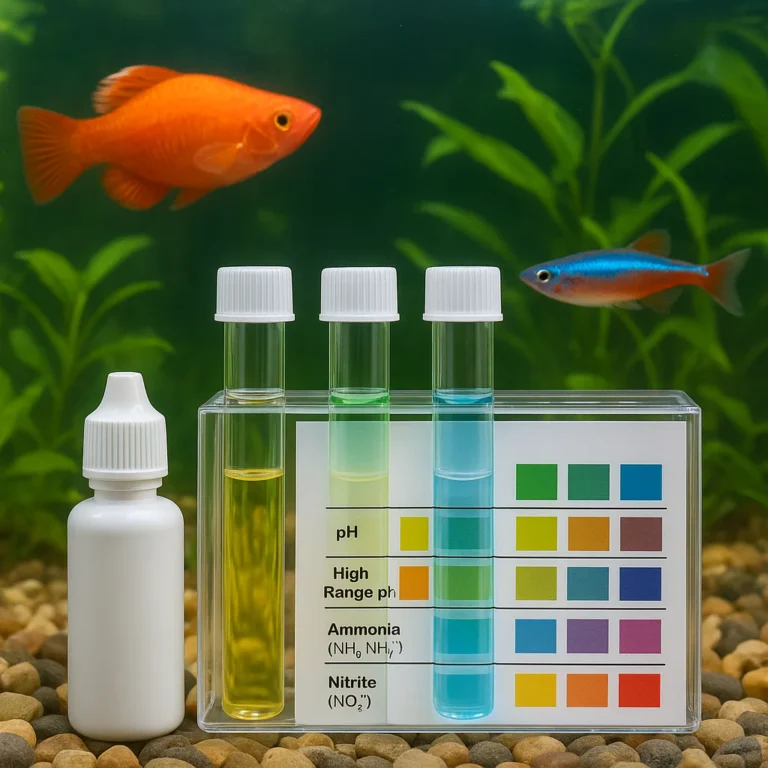
The API Freshwater Master Test Kit is one commonly used option for freshwater testing. Follow the kit instructions carefully, use unexpired reagents, and don’t guess at colors in a dim room. Test kits are helpful, but a single number isn’t the whole story: interpret readings alongside fish behavior and recent maintenance.
Amonia, Nitrite, and Nitrate: What to Check
| Parameter | Why it matters | What to do if a reading is concerning |
|---|---|---|
| Amonia | Toxic waste product; should generally be undetectable in a mature aquarium | Retest, check filtration and recent stocking, and act promptly to protect livestock |
| Nitrite | Toxic intermediate in the nitrogen cycle; should generally be undetectable in a stable tank | Verify the reading and address the source; consider an appropriate partial water change |
| Nitrate | Accumulates as waste is processed; useful for tracking maintenance needs | Compare with your baseline and species needs; adjust water changes and waste control |
| pH | Affects fish and biological processes; stability matters | Avoid chasing a target with sudden chemical changes |
| Temperature | Influences fish health and oxygen availability | Verify with a reliable thermometer and adjust gradually |
The USGS nitrogen-cycle overview helps explain why ammonia and nitrite deserve particular attention. Any detectable ammonia or nitrite in an established aquarium merits investigation, especially if fish show distress. A routine clean alone may not solve the cause.
How to Adjust Maintenance When Readings Change
If nitrate is steadily rising between water changes, increase the frequency or volume of partial changes and inspect feeding, stocking, and debris. If ammonia or nitrite appears, treat it as a water-quality issue—not simply a cue to scrub harder.
- Confirm the test result, checking instructions and expiry dates.
- Check whether anything recently changed: new fish, filter disruption, dead livestock, excess food, or medication.
- Remove visible decaying material and uneaten food.
- Make a carefully matched, conditioned partial water change if appropriate.
- Retest and monitor fish; seek an aquatic veterinarian or experienced specialist if the problem persists.
Avoid dramatic parameter changes based one questionable reading. The goal is stable, suitable water, not winning a test-kit color contest.
🪴 Planted, Freshwater, and Saltwater Tank Cleaning Schedules
The same cleaning routine won’t fit every aquarium. A heavily planted freshwater aquascape, a goldfish tank, and a reef tank have different waste patterns and water-chemistry demands.
| Tank type | Routine focus | Helpful reminder |
|---|---|---|
| Community freshwater | Partial water changes, debris removal, filter flow | Let test trends determine frequency |
| Planted aquascape | Trim plants, remove melting leaves, clean open substrate areas | Don’t disturb roots or repeatedly deep-clean the whole substrate |
| Goldfish aquarium | Strong filtration, frequent waste removal, consistent water testing | Waste load can be high for the tank volume |
| Marine fish-only | Stable salinity, waste removal, filtration and equipment checks | Replace water with correctly mixed saltwater |
| Reef aquarium | Stability, nutrient monitoring, equipment upkeep and husbandry | Avoid sudden salinity or chemistry changes |
In planted tanks, plants can consume nitrate and alter maintenance needs, but they don’t remove every dissolved waste product. For aquascaping inspiration and plant-care ideas, browse Aquascaping and Aquatic Plants.
Saltwater aquariums require extra care with salinity and replacement water. Measure salinity using an appropriate instrument and prepare new saltwater according to the salt mix manufacturer’s instructions. For product-specific guidance, see Red Sea’s reef-care resources.
🧹 Step-by-Step Fish Tank Cleaning Routine
A calm, repeatable routine beats an occasional aquarium overhaul. Here’s the order our aquascapers use for a typical freshwater maintenance session.
Before you start
Gather:
- A dedicated aquarium bucket
- A siphon or gravel vacuum
- A water conditioner suitable for your water supply
- A clean algae scraper or aquarium-safe pad
- A thermometer and water-test kit
- A towel for the inevitable drips—because gravity is undefeated
A siphon such as the Python water-changing system can make larger water changes easier. For smaller tanks, a basic manual gravel vacuum may be enough.
Cleaning steps
- Observe fish and equipment first. Look for unusual breathing, behavior, damaged plants, blocked intakes, or a drop in filter flow.
- Test the water if needed. Prioritize testing if the tank is new, recently stocked, or showing signs of trouble.
- Switch off equipment only when appropriate. Follow manufacturer guidance, especially for heaters and filters. Never let a heater run exposed to air.
- Clean the viewing glass. Use an aquarium-safe tool and keep abrasive grit away from the glass or acrylic.
- Remove visible waste. Siphon uneaten food, dead leaves, and debris from accessible areas.
- Vacuum part of the substrate. Work a section at a time; avoid uproting plants or disturbing the entire bed.
- Remove a measured amount of water. A partial change is usually preferable to a complete drain for routine maintenance.
- Prepare replacement water. Treat it as required and bring it reasonably close to the tank’s temperature.
- Refill gently. Avoid stirring the substrate or creating a current that baters fish and plants.
- Restart and check equipment. Confirm the filter is flowing, the heater is operating safely, and fish are behaving normally.
Keep a simple maintenance log
| Date | Water changed | Amonia / nitrite | Nitrate | Notes |
|---|---|---|---|---|
| Session 1 | Record amount or percentage | Record readings | Record reading | Feeding, algae, fish behavior |
| Session 2 | Record amount or percentage | Record readings | Record reading | Note any changes |
| Session 3 | Record amount or percentage | Record readings | Record reading | Compare trends |
After a few weeks, the log may reveal that your tank needs more maintenance after heavy feeding—or less substrate vacuuming than you assumed. That’s when the schedule starts belonging to your aquarium, not a generic checklist.
🚫 Cleaning Mistakes That Can Harm Fish and Beneficial Bacteria
A clean-looking tank can still be biologically destabilized by well-intended over-cleaning. Avoid these common pitfalls:
- ❌ Using soap, detergent, or household sprays on anything that goes in the aquarium.
- ❌ Replacing all filter media at once without a plan to preserve biological filtration.
- ❌ Rinsing biological media under untreated tap water when it can be gently rinsed in removed tank water instead.
- ❌ Deep-cleaning every part of the substrate at every maintenance session.
- ❌ Changing all the water routinely when a partial change would meet the need.
- ❌ Adding untreated tap water when chlorine or chloramine may be present.
- ❌ Chasing pH with abrupt chemical adjustments rather than investigating the source and keeping conditions stable.
- ❌ Overfeeding, then treating the resulting debris as a cleaning-schedule problem.
The Seachem guidance on biological filtration explains the role of beneficial bacteria in aquarium filtration. The filter isn’t just a debris basket; it’s a biological workhorse. Clean it gently, and only when its performance or condition calls for attention.
🚨 Signs Your Aquarium Needs Cleaning Soner
Your fish won’t check the calendar. Watch the aquarium instead.
| Sign | Possible cause | First response |
|---|---|---|
| Fish gasping at the surface | Water-quality problem, low oxygen, or equipment issue | Check aeration and temperature; test water promptly |
| Uneaten food or visible waste | Overfeeding or missed debris | Remove it and review feeding amounts |
| Filter flow noticeably reduced | Clogged intake or media | Inspect and clean gently according to the filter guidance |
| Persistent cloudy water | New tank, microbial bloom, excess waste, or other issue | Test water and investigate the cause before deep-cleaning |
| Rotten or unusual odor | Decaying organic material or equipment issue | Search for dead livestock, trapped debris, and water-quality problems |
| Rapid algae growth | Excess light, nutrients, or imbalance | Clean the viewing pane and review lighting and feeding |
| Rising nitrate between changes | Waste load exceeding current routine | Increase maintenance and review stocking and feeding |
Cloudy water does not automatically mean “change all the water.” It can have several causes, and aggressive cleaning may make a new or unstable aquarium less stable. Check the water, identify the cause, and make measured changes.
📅 Build a Simple Aquarium Maintenance Calendar
A calendar keeps routine jobs from becoming a Saturday-long rescue mission. Start here, then tailor the plan to test results and livestock.
| Frequency | Suggested task |
|---|---|
| Daily | Observe fish; check temperature and equipment; remove obvious uneaten food |
| Weekly | Test water as needed; perform a partial water change based on your tank’s needs; clean visible algae |
| Every 1–2 weeks | Vacuum accessible substrate areas and remove decaying plant matter |
| Every few weeks | Inspect filter flow and clean clogged media gently if needed |
| Monthly | Review test trends, equipment condition, and feeding or stocking changes |
This calendar is a starting framework, not a mandate. A newly cycled tank, an aquarium with sensitive livestock, or a heavily stocked setup may need more frequent testing and intervention. A mature, lightly stocked planted tank may need a different balance.
We’ve now reached the question behind every maintenance schedule: should you trust the calendar, the glass, or the test kit? Trust the test kit and the fish first; use the calendar to remember when to look.