Support our educational content for free when you purchase through links on our site. Learn more
10 Fish Tank Water Parameters to Monitor 🧪


To maintain optimal water quality in your fish tank, test regularly, keep conditions stable, and respond to the cause of a problem—not just the number on a test kit. The key parameters to monitor include amonia, nitrite, nitrate, pH, temperature, GH, and KH; for an established aquarium, ammonia and nitrite should read 0 ppm.
That answers the big question: How do I maintain optimal water quality in my fish tank, and what are the key parameters to monitor, such as pH and ammonia levels? Start by testing your source water and aquarium, then track results over time. Stable, species-appropriate water is usually safer than chasing a “perfect” pH with sudden chemical fixes.
We’ve seen clear tanks fool even experienced fishkeepers: a glass-box aquarium can look pristine while ammonia quietly climbs after a filter disruption. A simple testing routine, sensible feeding, conditioned water changes, and a healthy biofilter help catch trouble before your fish have to wave a tiny red flag. 🐟
Key Takeaways
- Test ammonia and nitrite: Aim for 0 ppm in an established tank; investigate any detectable reading.
- Track nitrate, pH, and temperature: Interpret results in context of your fish, plants, and source water.
- Keep conditions stable: Avoid abrupt changes to pH, temperature, and hardness.
- Maintain the biofilter: Preserve beneficial bacteria, clean filter media gently, and don’t replace it all at once.
- Use regular, conditioned water changes: Match replacement water to the aquarium and let test results guide your routine.
- Keep a water log: Trends often reveal a problem before fish show symptoms.
Table of Contents
- ⚡ Quick Tips and Facts
- 🐠 Why Aquarium Water Quality Matters
- 🧪 The 10 Essential Aquarium Water Parameters to Monitor
- 1. Amonia: The First Sign of a Dangerous Problem
- 2. Nitrite: A Toxic Byproduct of the Nitrogen Cycle
- 3. Nitrate: Managing the End Product of Biofiltration
- 4. pH: Measuring How Acidic or Alkaline Water Is
- 5. General Hardness (GH): Calcium and Magnesium
- 6. Carbonate Hardness (KH): Buffering Capacity and pH Stability
- 7. Water Temperature: Matching Fish and Invertebrate Needs
- 8. Dissolved Oxygen: Keeping Aquarium Water Well Aerated
- 9. Chlorine and Chloramine: Treating Tap Water Safely
- 10. Phosphate and Other Nutrients: Algae, Plants, and Aquarium Balance
- 🌿 Water Quality in Planted Aquariums
- Nutrients, Fertilizers, and CO₂
- Detritus and Setleable Solids
- 🚰 Know Your Source Water Before You Change the Tank
- Tap Water, Well Water, RO Water, and Distilled Water
- How to Read a Municipal Water Quality Report
- 📅 How Often to Test Aquarium Water
- Testing Frequency for New, Established, and Overstocked Tanks
- Liquid Test Kits, Test Strips, and Digital Meters
- How to Get Accurate Water Test Results
- 🔄 The Aquarium Nitrogen Cycle and Biological Filtration
- How Beneficial Bacteria Convert Amonia to Nitrate
- Fishless Cycling: A Safer Way to Establish a Biofilter
- Cycling an Aquarium with Fish
- How to Tell When the Biofilter Is Fully Cycled
- 🧽 Aquarium Maintenance for Stable Water Quality
- Water Changes: How Much and How Often
- Gravel Vacuuming and Removing Waste
- Filter Cleaning Without Losing Beneficial Bacteria
- Feding, Stocking, and Other Sources of Excess Waste
- 🚨 Troubleshooting Aquarium Water Quality Problems
- Amonia Levels Too High: Immediate Steps
- Nitrite Levels Too High: Protecting Fish from Nitrite Poisoning
- Nitrate Levels Too High: Reducing Chronic Waste Buildup
- pH Is Too High or Too Low: Safe, Gradual Adjustments
- Low KH or Suden pH Swings
- Cloudy Water, Algae, and Unusual Odors
- Fish Gasping at the Surface or Acting Unwell
- 🐟 Choosing Water Conditions for Your Fish
- Freshwater Community Tanks
- Species-Specific Needs: Bettas, Goldfish, and Cichlids
- Shrimp and Sensitive Invertebrates
- Freshwater and Saltwater Water Quality Differences
- 🧰 Quick Aquarium Water Quality Checklist
- ❓ Frequently Asked Questions About Fish Tank Water Quality
- What Should pH, Amonia, Nitrite, and Nitrate Be in a Fish Tank?
- How Do I Know If My Aquarium Water Is Safe for Fish?
- Can I Change Aquarium pH Quickly?
- Why Is Amonia Present in a Fully Cycled Tank?
- Conclusion
- Recommended Links
- Reference Links
Quick Tips and Facts
The fastest route to healthier aquarium water isn’t chasing a perfect number. It’s testing consistently, keeping conditions stable, and correcting the cause—not just the test result. If you’re setting up a new aquarium, start with our guide to How Do I Cycle a New Fish Tank? 17 Steps for Healthy, Happy Fish 🐟. 🧪
| What to monitor | Practical goal for many freshwater aquariums | Why it matters |
|---|---|---|
| Amonia | 0 ppm | Toxic waste; any reading merits investigation |
| Nitrite | 0 ppm | Toxic nitrogen-cycle intermediate |
| Nitrate | Keep it low and appropriate to your livestock; under 40 ppm is a commonly used upper limit, with sensitive species often needing less | Accumulates as the biofilter processes waste |
| pH | Species-dependent; stability matters | Affects fish physiology and ammonia toxicity |
| Temperature | Species-dependent and steady | Affects metabolism, oxygen availability, and ammonia toxicity |
| GH and KH | Species- and source-water-dependent | GH supplies important minerals; KH helps resist pH swings |
| Dissolved oxygen | Maintain good surface agitation and aeration | Fish and beneficial bacteria need oxygen |
Quick-start routine:
- ✅ Test amonia and nitrite daily during cycling, after a filter failure, or when fish appear unwell.
- ✅ Test a stable aquarium weekly at first, then adjust frequency based on your records and risk.
- ✅ Use a water conditioner that treats the disinfectant in your tap water. Chloramine requires more than simply letting water stand.
- ✅ Change water based on test results, stocking, feeding, and maintenance—not a rigid percentage alone.
- ❌ Don’t make abrupt pH corrections just to hit a textbook number. A stable, suitable pH is usually safer than a sudden “perfect” one.
- ❌ Don’t rinse biological filter media under untreated tap water or replace all media at once.
- 📝 Keep a log. One reading is a snapshot; a trend is a clue.
Aquarium parameters and pond targets aren’t interchangeable. New Mexico State University’s pond-water guide explains that oxygen, ammonia, and pH shift with temperature, sunlight, and algae. Those principles help us understand aquariums, but pond-specific target ranges shouldn’t be copied blindly into a home tank.
🐠 Why Aquarium Water Quality Matters
Fish live in the water they breathe, eat, and excrete into. That means water quality isn’t a background detail; it’s part of their habitat and health. A clear tank can still contain ammonia, while a slightly tinted tank may be perfectly suitable. Appearance is not a substitute for testing.
At Aquarium Music™, we think of a healthy aquarium as a small aquatic neighborhood: fish produce waste, microbes process it, plants use some nutrients, and you manage the traffic. When one part falls behind—say, too much food for the biofilter to process—waste builds up quickly.
The New Mexico State University aquaponics circular describes its system as one where fish, plants, and nitrifying bacteria must share compatible conditions. Its useful takeaway is that “optimal water quality is essential to a healthy, balanced, functioning system.” That principle applies to aquariums too, though the ideal values depend on your fish, plants, filtration, and setup.
Stable conditions beat number-chasing
Fish can often adapt to a range of water conditions, but sudden shifts can stress them. This is especially true for pH, temperature, salinity, and hardness. A fish accustomed to stable, moderately hard water may fare worse after a rapid chemistry adjustment than in water that is slightly outside a generic “ideal” range.
That’s why we recommend a two-part approach:
- Choose species that fit your water, rather than constantly trying to remodel your water around incompatible species.
- Make changes gradually, with measurements before and after.
For more practical setup and stocking guidance, browse our Aquarium Setup and Fish Care and Species Profiles sections.
What poor water quality can look like
Some problems announce themselves; others hide in plain sight. Watch for:
- Fish gasping near the surface or filter outlet
- Clamped fins, lethargy, hiding, or loss of appetite
- Red or inflamed gills, unusual mucus, or erratic swimming
- Suden algae growth, persistent cloudiness, or foul odors
- Deaths after a water change, filter cleaning, or power outage
These signs aren’t proof of one particular water problem. Disease, temperature shock, and aggression can look similar. Test first, then act on evidence. If fish are in distress, increase aeration and check temperature and ammonia while you investigate.
🧪 The 10 Essential Aquarium Water Parameters to Monitor
Not every aquarium needs every test every week. A basic freshwater community tank generally calls for close attention to amonia, nitrite, nitrate, pH, and temperature. GH and KH become especially useful when you keep species with specific mineral needs, experience pH instability, or use water that differs from the source.
| Parameter | What it measures | When it deserves extra attention |
|---|---|---|
| Amonia | Total ammonia from fish waste, uneaten food, and decay | New tanks, filter issues, overfeeding, sick fish |
| Nitrite | A toxic intermediate in the nitrogen cycle | Cycling or biofilter disruption |
| Nitrate | A final product of nitrification; also a plant nutrient | Routine maintenance and heavy stocking |
| pH | Acidity or alkalinity | Source-water checks, fish acclimation, pH swings |
| GH | Mainly calcium and magnesium | Shrimp, livebearers, cichlids, breeding |
| KH | Buffering capacity, commonly associated with carbonate and bicarbonate | Low-buffer water, falling pH, planted tanks |
| Temperature | Water warmth | Always; especially during seasons and water changes |
| Dissolved oxygen | Oxygen available in water | Warm weather, low surface movement, emergencies |
| Chlorine/chloramine | Water-treatment disinfectants | Every tap-water change |
| Phosphate and nutrients | Plant/algae nutrients and organic inputs | Planted tanks, algae issues, specialized systems |
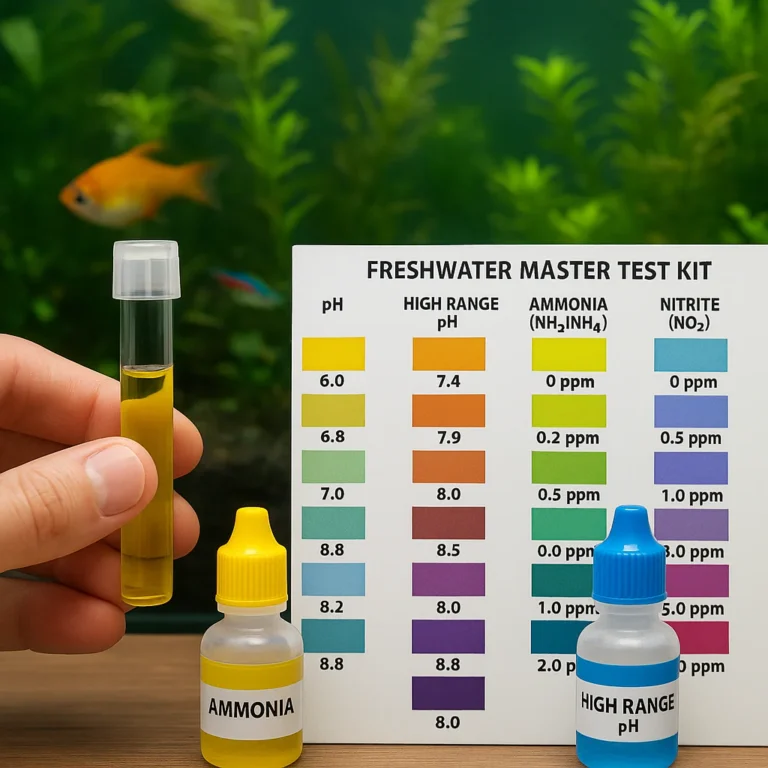
Aquarium kits such as the API Freshwater Master Test Kit and Salifert test kits can help build a repeatable testing routine. Follow each kit’s instructions carefully; reagents and reading methods differ.
1. Amonia: The First Sign of a Dangerous Problem
For an established aquarium, the target is 0 ppm ammonia. Amonia enters the water through fish waste, decomposing food, decaying plants, and other organic matter. A functioning biofilter processes it, but a new tank or disrupted filter may not have enough beneficial bacteria to keep up.
Amonia exists in two forms:
- NH₃ (un-ionized ammonia): more toxic to fish
- NH₄⁺ (amonium): generally less toxic
Most hobby tests report total ammonia, which combines these forms. The fraction present as toxic NH₃ increases as pH and temperature rise. That’s why a low-looking total ammonia reading can be more concerning in warm, alkaline water than in cooler, more acidic water.
New Mexico State University’s aquaponics guidance notes that at pH 7 or below, most total ammonia is typically in the less-toxic ammonium form; as pH rises, the NH₃ fraction rises too. That chemistry is useful context, but it doesn’t make a nonzero ammonia reading safe to ignore in an aquarium.
If your test shows ammonia:
- Confirm the reading and check the test kit’s expiry date and instructions.
- Check for dead livestock, leftover food, clogged filter media, or a recent filter cleaning.
- Test nitrite and pH, and verify temperature.
- Improve surface movement and aeration.
- Reduce feeding temporarily and remove uneaten food.
- If fish are distressed or ammonia is elevated, perform a partial water change using conditioned, temperature-matched water.
- Retest and keep tracking the result until it returns to zero.
Some conditioners, including Seachem Prime, are marketed for treating chlorine, chloramine, and certain nitrogen compounds. A conditioner does not replace water changes, testing, or biological filtration. Follow the label, and be aware that some ammonia test methods may behave differently after conditioner use.
2. Nitrite: A Toxic Byproduct of the Nitrogen Cycle
Target: 0 ppm. Nitrite (NO₂⁻) appears when bacteria process ammonia. A second group of bacteria then converts nitrite into nitrate. During cycling, or after biological filtration is damaged, nitrite can rise before the biofilter catches up.
Nitrite interferes with oxygen transport in fish. Fish may appear lethargic or breathe rapidly, but symptoms alone are not diagnostic. Test it rather than guessing.
If nitrite is detected:
- Check ammonia and nitrate too; the pattern can reveal where the biofilter is struggling.
- Increase aeration and stop overfeeding.
- Use a partial water change with conditioned water when needed.
- Keep testing daily until nitrite consistently reads zero.
Some fishkeepers use chloride-containing products to reduce nitrite uptake in certain situations, but species and water chemistry matter. Don’t add salt as a universal fix, especially in tanks containing salt-sensitive plants, catfish, or invertebrates. When in doubt, prioritize water changes, aeration, and a functioning biofilter.
3. Nitrate: Managing the End Product of Biofiltration
Nitrate (NO₃⁻) is produced as the biofilter processes nitrite. It is much less acutely toxic than ammonia or nitrite, but persistent high nitrate can still contribute to stress and poor conditions, and it often signals that waste is accumulating faster than the aquarium is removing it.
Many freshwater keepers use under 40 ppm as a practical upper limit, while sensitive fish, shrimp, and breeding setups may benefit from lower levels. Treat that as a general husbandry guide, not a universal line between safe and unsafe. Fish species, exposure time, and tank conditions matter.
In planted aquariums, plants use nitrate as a nutrient. But “plants will take care of it” is not a maintenance plan: growth rate, lighting, plant mass, and feeding all affect uptake.
To reduce nitrate sustainably:
- Change water regularly, using water that is safe and appropriate for your livestock.
- Remove detritus and uneaten food.
- Avoid overstocking and overfeeding.
- Grow healthy aquatic plants if they suit your setup.
- Check source-water nitrate; a water change can’t lower nitrate much if the replacement water already contains it.
4. pH: Measuring How Acidic or Alkaline Water Is
The pH scale runs from acidic below 7 to alkaline above 7. There is no single ideal pH for every fish tank. Many common aquarium fish can thrive across a moderate range when conditions are stable, but species from specialized habitats may need particular water chemistry.
pH also affects ammonia toxicity: higher pH increases the proportion of ammonia present as toxic NH₃. It can influence how some metals and treatments behave as well. Check pH alongside ammonia, not as an isolated number.
A pH reading that shifts over the day can be related to photosynthesis and respiration. In planted and algae-rich systems, carbon dioxide is consumed during photosynthesis and released during respiration. That may create a daily cycle; the size and significance vary by aquarium.
Best practice: test source water and aquarium water, compare readings, and record them. If you’re considering changing pH, first investigate KH, water-change routine, substrate, decorations, and CO₂ use. Avoid “pH up” or “pH down” as a reflex. A sudden correction can do more harm than a stable value that is modestly different from a chart.
5. General Hardness (GH): Calcium and Magnesium
GH measures dissolved minerals, mainly calcium and magnesium. These minerals matter to fish and invertebrate physiology, and many aquatic species are adapted to particular mineral conditions.
- Soft-water species may come from habitats with relatively low mineral content.
- Livebearers and many African cichlids generally prefer harder, mineral-rich water.
- Shrimp species can have specific GH requirements, especially during molting and breeding.
GH is often measured in degrees of general hardness (°dGH) or parts per million (ppm). Different test kits may display different units, so check the label before comparing readings.
Don’t confuse GH with KH. They’re related to water chemistry but measure different things. The featured video’s perspective is especially useful here: its explanation of GH, KH, and stability stresses that calcium and magnesium support fish physiology, while KH provides buffering capacity. The video’s suggested ranges are broad hobby guidance; species-specific care information should take priority.
6. Carbonate Hardness (KH): Buffering Capacity and pH Stability
KH is commonly used by aquarists as a measure of carbonate and bicarbonate buffering. It helps water resist rapid pH changes as acids accumulate from respiration, decomposition, and nitrification.
A low KH aquarium may be more prone to a pH crash, particularly if it has substantial biological activity and infrequent maintenance. But a high KH isn’t automatically better: the right level depends on the livestock, plants, and water source.
The featured video recommends maintaining at least 60 ppm KH for many tanks as a general stability measure. That can be a helpful starting point, not a universal target—soft-water fish and specialized aquascapes may be maintained differently. The aquaponics circular gives a higher alkalinity target for its recirculating production systems; those systems have different operating demands, so its numbers shouldn’t be directly transplanted into every aquarium.
| GH | KH | What it may indicate |
|---|---|---|
| Low | Low | Soft, weakly buffered water; watch for pH instability |
| High | Low | Mineral-rich water with limited carbonate buffering |
| Low | High | Possible in some source waters; measure rather than infer |
| High | High | Hard, well-buffered water, often suited to hard-water species |
7. Water Temperature: Matching Fish and Invertebrate Needs
Temperature affects fish metabolism, oxygen availability, and the balance between ammonia and ammonium. Warm water holds less dissolved oxygen, while higher temperatures can increase fish and bacterial metabolic demands.
Use a reliable aquarium thermometer and choose a temperature based on the species you keep—not a generic “tropical” label. Set heaters to maintain stability and verify the actual water temperature rather than trusting the dial.
For equipment guidance, see our Aquarium Equipment section. In a heated tank, a second thermometer is useful for checking whether the heater is behaving as expected.
Temperature-change checklist:
- Match replacement water closely to tank temperature.
- Avoid placing heaters where they can run dry or be blocked by décor.
- Check temperature during heat waves and cold snaps.
- Increase aeration if water is unusually warm or fish are breathing quickly.
- Never cool a tank abruptly with ice or sudden large additions of cold water.
8. Dissolved Oxygen: Keeping Aquarium Water Well Aerated
Fish, beneficial bacteria, and many other aquatic organisms use oxygen. Oxygen enters the aquarium mainly through gas exchange at the surface, so surface movement matters. A filter return, air stone, or circulation pump can help, but bubbles themselves aren’t magic: it’s the movement and exchange that do the heavy lifting.
The pond guide from New Mexico State University calls dissolved oxygen “probably the single most important water quality factor for pond owners.” That emphasis reflects pond-scale risks such as algae crashes and stratification, but the core lesson applies to aquariums: oxygen shortages can become serious quickly. The same guide notes that warm water holds less oxygen than cooler water.
Improve gas exchange by:
- Directing the filter outlet to gently ripple the surface.
- Adding an air stone or sponge filter if circulation is insufficient.
- Keeping filters and intake screens clear.
- Avoiding excessive organic waste, which consumes oxygen as it decomposes.
- Checking fish behavior, especially after equipment failure or during hot weather.
9. Chlorine and Chloramine: Treating Tap Water Safely
Tap water may contain chlorine or chloramine to control microbes. These disinfectants can harm fish and beneficial bacteria, so treat replacement water before it enters the aquarium. Municipal providers often publish water-quality information; check your supplier’s report and ask whether it uses chloramine.
A water conditioner should explicitly state that it treats the disinfectant present in your water. For example, Seachem Prime is a widely used conditioner labeled for chlorine and chloramine treatment. Follow the product directions and measure carefully.
✅ Do: condition new water, match temperature, and add it gradually when appropriate.
❌ Don’t: assume letting water stand removes chloramine, or pour untreated tap water into a tank because “it worked last time.”
10. Phosphate and Other Nutrients: Algae, Plants, and Aquarium Balance
Phosphate and nitrogen compounds support plant growth, but excess inputs can encourage algae. Nutrients may come from fish food, source water, fertilizers, and decaying organic matter. Algae is usually a symptom of an imbalance, not a villain that arrived with a personal grudge. 🌱
If algae keeps returning:
- Test nitrate and phosphate, including source water if practical.
- Review feeding amounts and remove leftovers.
- Check lighting duration and intensity.
- Remove decaying leaves and accumulated detritus.
- Make maintenance changes gradually and consistently.
For planted-tank advice, visit Aquascaping and Aquatic Plants. Don’t remove all nutrients indiscriminately: aquatic plants need them too, and starving plants can create another imbalance.
🌿 Water Quality in Planted Aquariums
A planted tank uses nutrients differently from a bare or lightly planted aquarium. Plants can take up nitrate and other nutrients, but they also respire, shed leaves, and add organic matter when growth declines.
Nutrients, Fertilizers, and CO₂
Fertilizer should be matched to plant mass, lighting, and CO₂ availability. Adding more fertilizer to solve slow growth without checking light, carbon availability, or nutrient balance is a bit like adding more fuel to a car with a blocked air filter.
For stable plant and livestock care:
- Follow the fertilizer manufacturer’s directions and start conservatively.
- Track plant response and algae rather than treating a single test result as the whole story.
- Ensure fish have adequate oxygen, especially at night when plants respire.
- If using injected CO₂, monitor fish behavior and avoid excessive dosing.
Detritus and Setleable Solids
Fish waste, uneaten food, dead leaves, and other debris settle into the substrate or collect in the filter. As this material decomposes, it can consume oxygen and add ammonia and nutrients to the water. In aquaponics, New Mexico State University notes that feed and solids management are central to keeping the system functioning; aquarium keepers face the same basic biology on a smaller scale.
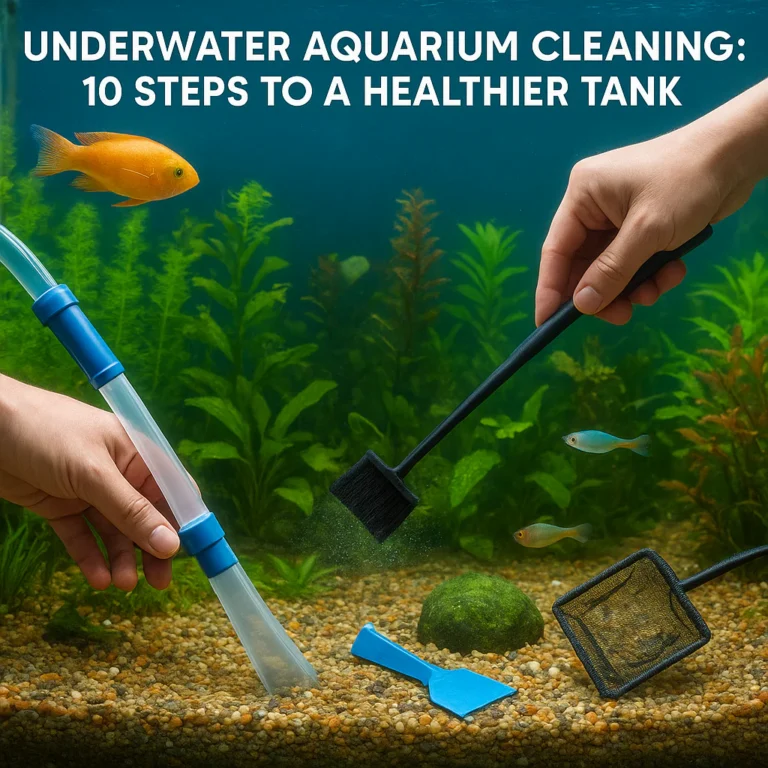
Remove debris with a gravel vacuum, siphon, or targeted cleaning. Don’t strip the aquarium spotless all at once: preserve beneficial bacteria and avoid disturbing delicate plants or livestock unnecessarily.
🚰 Know Your Source Water Before You Change the Tank
Your tap water is part of your aquarium system. If source water contains high nitrate, unusual pH, low KH, or a disinfectant you haven’t treated, routine water changes may not produce the result you expect.
Test source water for pH, GH, KH, nitrate, and disinfectants as relevant. Compare it with tank readings and keep the results in your log.
Tap Water, Well Water, RO Water, and Distilled Water
| Water type | Potential advantages | Watch-outs |
|---|---|---|
| Municipal tap | Convenient; often consistent | Chlorine/chloramine, nitrate, minerals, seasonal changes |
| Well water | May avoid municipal disinfectants | Can contain dissolved minerals, gases, metals, or contaminants |
| Reverse-osmosis (RO) | Low dissolved mineral content; useful for controlled blending | Usually needs remineralizing for fish and plants |
| Distilled | Very low mineral content | Not usually suitable alone for routine aquarium use without remineralization |
RO water is a tool, not a shortcut. Fish still need appropriate mineral conditions, and sudden changes from hard tap water to nearly mineral-free water can cause stress. Blend and remineralize deliberately for the species you keep.
How to Read a Municipal Water Quality Report
Look for terms such as chlorine, chloramine, nitrate, hardness, alkalinity, and pH. Reports may describe treated water at the treatment plant, while the water reaching your home may vary with plumbing or season.
If you use well water, consider testing through a reputable laboratory, especially if the well is new, near agricultural land, or has changed in taste, color, or odor. Never assume clear water is chemically suitable.
📅 How Often to Test Aquarium Water
Testing frequency should match risk. A new tank, a heavily stocked aquarium, or a tank recovering from illness needs more attention than a stable, lightly stocked setup.
Testing Frequency for New, Established, and Overstocked Tanks
| Situation | Suggested checks |
|---|---|
| New tank / cycling | Amonia and nitrite daily or as directed by the cycling plan; temperature daily |
| First weeks after adding fish | Amonia and nitrite frequently; nitrate and pH at least weekly |
| Stable established tank | Weekly checks initially, then a consistent schedule based on trend and stocking |
| After filter disruption or fish distress | Test ammonia, nitrite, nitrate, pH, and temperature promptly |
| Before and after a major water change | Check source water and compare relevant readings |
| Planted or specialty tank | Add GH, KH, phosphate, or other tests as the system requires |
New Mexico State University’s aquaponics publication recommends daily monitoring for new systems and weekly testing once the system is balanced. That’s a reasonable model for attentive fishkeepers, although a conventional aquarium’s test schedule should be tailored to its stocking and maintenance history.
Liquid Test Kits, Test Strips, and Digital Meters
Liquid kits are popular for routine freshwater testing because they cover several parameters. Test strips are quick and convenient, but results can be harder to distinguish and may not cover every parameter. Digital meters can be useful for pH or conductivity, but require calibration and maintenance.
- API Freshwater Master Test Kit: a common option for ammonia, nitrite, nitrate, and pH checks.
- JBL ProAquaTest: a range of aquarium testing kits from JBL.
- Hanna Instruments aquarium testing products: digital and reagent-based measurement tools.
A kit is only useful if it’s stored correctly and read at the specified time. Replace expired reagents and avoid contaminating sample tubes.
How to Get Accurate Water Test Results
- Rinse the test vial as directed, generally with the water sample rather than soap.
- Collect a representative sample away from the filter outlet if possible.
- Use the exact amount of water and reagent.
- Cap and mix as instructed; don’t improvise the timing.
- Compare colors under neutral, bright lighting.
- Record the value, date, and any recent maintenance or feeding changes.
- If a reading is surprising, repeat the test and compare with another reliable method if available.
The log is where the story appears. A pH that slips slightly each week alongside falling KH tells you more than one isolated “normal” reading.
🔄 The Aquarium Nitrogen Cycle and Biological Filtration
A biofilter is home to microorganisms that convert fish waste into less harmful forms. It doesn’t make waste disappear; it changes the chemistry of the waste, which is why water changes and cleaning still matter.
How Beneficial Bacteria Convert Amonia to Nitrate
The simplified sequence is:
Amonia/amonium → nitrite → nitrate
Nitrifying microbes colonize filter media, substrate, and other wet surfaces. They need oxygen and time to establish. The process also consumes alkalinity, so a tank with low KH may gradually experience a pH decline.
Fishless Cycling: A Safer Way to Establish a Biofilter
Fishless cycling establishes the biofilter before fish are exposed to ammonia and nitrite. Use an aquarium-specific cycling plan and a clean ammonia source intended for this purpose. Avoid household products that contain fragrance, surfactants, or other additives.
Test ammonia and nitrite during the process. A tank isn’t reliably cycled just because nitrate appears once; the biofilter should be able to process an appropriate ammonia load and return amonia and nitrite to zero. For a detailed sequence, follow our linked new-tank cycling guide.
Cycling an Aquarium with Fish
Fish-in cycling is sometimes unavoidable, but it exposes livestock to a developing biofilter and calls for close monitoring. Keep stocking low, feed sparingly, test frequently, and make water changes when ammonia or nitrite is detectable at concerning levels.
Don’t add extra fish to “speed up” cycling. More fish create more waste, not instant bacterial capacity.
How to Tell When the Biofilter Is Fully Cycled
Look for a repeated pattern:
- Amonia returns to zero after an appropriate waste input.
- Nitrite returns to zero.
- Nitrate may rise, unless plants or water changes remove it.
- Results remain stable under the aquarium’s normal feeding and stocking routine.
A bottled bacteria product may help seed or support a biofilter, but it does not remove the need for testing. Products such as FritzZyme 7 and Seachem Stability are examples of commercially available bacterial products; follow the manufacturer’s instructions and treat results—not marketing claims—as the evidence that your filter is working.
🧽 Aquarium Maintenance for Stable Water Quality
A repeatable maintenance routine is usually more effective than a dramatic cleanup after a crisis. We like to divide care into small jobs so the aquarium doesn’t get the full “spring cleaning, but make it aquatic” treatment in one go.
Water Changes: How Much and How Often
There is no single percentage that fits every tank. The right schedule depends on nitrate accumulation, stocking density, feeding, plants, and source water. Start with consistent partial changes, test before and after, and adjust the routine based on results.
For each water change:
- Prepare replacement water in a clean, aquarium-safe container.
- Treat for chlorine or chloramine.
- Match temperature closely.
- Siphon debris if needed.
- Refill gently to avoid stressing fish or uproting plants.
- Test again if you’re correcting a water-quality problem.
Gravel Vacuuming and Removing Waste
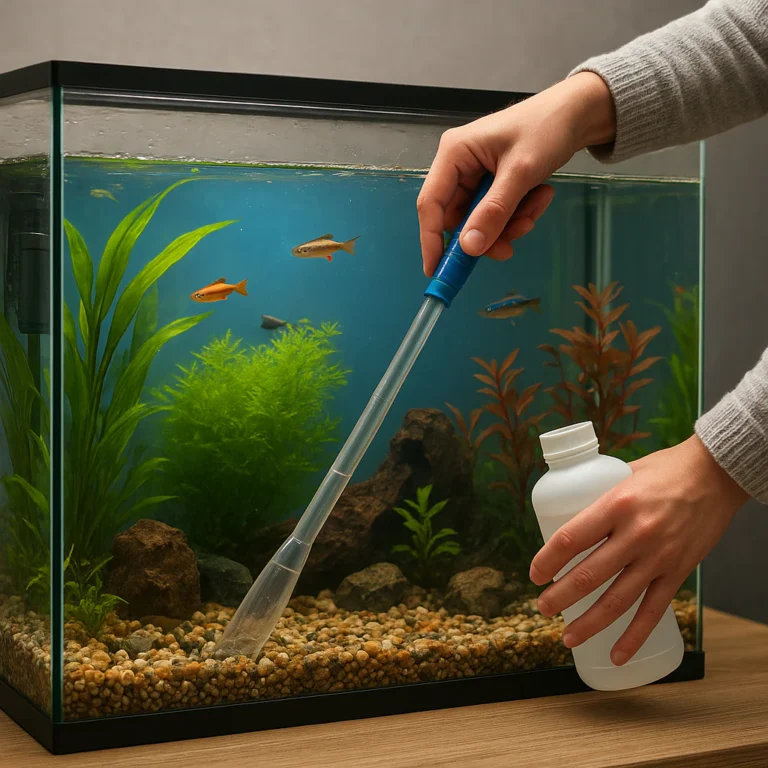
A gravel vacuum helps remove debris from the substrate while extracting water. Work in sections, especially in planted tanks, where aggressive vacuuming can disturb roots and beneficial surfaces. Remove dead leaves and uneaten food promptly.
Filter Cleaning Without Losing Beneficial Bacteria
The filter contains much of the tank’s biological capacity. Clean it when flow drops or debris accumulates, but don’t sterilize it.
- Rinse reusable media in siphoned aquarium water or appropriately conditioned water.
- Preserve biological media whenever possible.
- Avoid replacing all media at once.
- Never use soap or household cleaners.
- Check impellers, intakes, and tubing for blockage.
More equipment and upkeep guidance is available in our Aquarium Equipment category.
Feeding, Stocking, and Other Sources of Excess Waste
Overfeeding and overstocking can overwhelm the biofilter. Feed an amount fish can consume promptly, then remove leftovers. Consider the adult size and waste production of each species, not just how small it looks at the shop.
A tank can be crowded even when it looks spacious: fish need swimming room, territory, and appropriate filtration. Explore our Fish and Aquatic Life resources before adding new livestock.
🚨 Troubleshooting Aquarium Water Quality Problems
When something changes, avoid treating the first visible symptom as the whole diagnosis. Test, identify the likely source, and make one controlled correction at a time. If fish are in acute distress, prioritize oxygenation and safe dilution while you investigate.
Amonia Levels Too High: Immediate Steps
- Increase aeration and ensure the filter is running.
- Remove dead organisms and uneaten food.
- Stop or reduce feeding briefly.
- Test ammonia, nitrite, pH, and temperature.
- Perform a partial water change with conditioned, temperature-matched water.
- Retest and repeat appropriate water changes if ammonia remains elevated.
- Check whether the filter was recently replaced, cleaned too aggressively, or interrupted.
Nitrite Levels Too High: Protecting Fish from Nitrite Poisoning
Test again, increase aeration, and use a partial water change when needed. Investigate why the biofilter is not converting nitrite: the tank may be cycling, the filter may be damaged, or the bioload may have increased too quickly. Don’t add salt or chemical remedies without checking species compatibility and product directions.
Nitrate Levels Too High: Reducing Chronic Waste Buildup
Confirm the result, test source water, and review water-change frequency, feeding, stocking, and substrate debris. Plants can help use nitrate, but they won’t compensate for persistent overfeeding or inadequate maintenance.
pH Is Too High or Too Low: Safe, Gradual Adjustments
First test pH, KH, and source water. Check for carbonate-rich rocks or substrate, CO₂ changes, and recent water changes. If adjustment is truly needed, use a species-appropriate plan and move gradually.
Avoid adding acid or alkaline buffers by guesswork. A large, rapid pH shift can stress fish, and increasing pH can raise the toxic fraction of any ammonia present. Resolve ammonia first and stabilize the system before pursuing pH changes.
Low KH or Suden pH Swings
Low KH means limited buffering, so routine biological activity can shift pH more easily. Confirm the KH test, then identify the cause: low-mineral source water, heavy nitrification, accumulated organic acids, or a recent water change.
Some aquarists use crushed coral or mineral products to raise buffering, while others use RO water and remineralization to control chemistry. Either approach should be matched to the fish and introduced gradually. The featured video makes a useful point: stable water is generally safer than repeatedly chasing a specific pH number.
Cloudy Water, Algae, and Unusual Odors
Cloudiness can come from suspended debris, a bacterial bloom, substrate disturbance, or other causes. Algae can follow excess nutrients, lighting imbalance, or inconsistent maintenance. A foul smell may indicate decaying organic material or a stagnant area.
- Test water before using clarifiers or algaecides.
- Remove decaying matter and check filter flow.
- Review lighting and feeding.
- Avoid products that may harm invertebrates or plants unless you’ve confirmed compatibility.
Fish Gasping at the Surface or Acting Unwell
Immediately check temperature, filter flow, and surface agitation. Test ammonia and nitrite, and increase aeration. If several fish are affected at once, think first about a shared environmental issue—such as oxygen shortage, disinfectant exposure, or a temperature shock—rather than assuming several unrelated illnesses appeared together.
🐟 Choosing Water Conditions for Your Fish
Fish species evolved in different habitats. A useful aquarium plan begins with the livestock, then considers source water and equipment. Choose compatible species; don’t force a community tank to satisfy incompatible chemistry needs.
Freshwater Community Tanks
Many common community fish adapt to moderately stable conditions, but verify requirements for every species. Avoid mixing fish that need substantially different temperatures, hardness, or pH just because they share a label like “tropical.”
Species-Specific Needs: Bettas, Goldfish, and Cichlids
Bettas, goldfish, and cichlids differ widely in temperature, space, water chemistry, and waste output. Goldfish, for example, produce substantial waste relative to their size; filtration and maintenance should reflect their adult needs. African Rift Lake cichlids generally need harder, more alkaline water than many soft-water South American species.
Check reputable care information before purchase through our Fish Care and Species Profiles section.
Shrimp and Sensitive Invertebrates
Shrimp can be sensitive to sudden changes in GH, KH, temperature, and contaminants such as copper. Test water carefully, acclimate gradually, and avoid medications or fertilizers unless they’re confirmed safe for the species.
Freshwater and Saltwater Water Quality Differences
Saltwater systems require additional measurements, including salinity or specific gravity, and often alkalinity, calcium, and magnesium—especially in reef aquariums. Freshwater pH and hardness guidance does not cover reef chemistry. Use test kits and husbandry references designed for marine aquariums.
🧰 Quick Aquarium Water Quality Checklist
Daily or routine visual checks
- ✅ Confirm the filter and heater are operating.
- ✅ Check that fish are breathing and swimming normally.
- ✅ Remove uneaten food and dead leaves.
- ✅ Look for unusual cloudiness, odors, or surface films.
Weekly or scheduled checks
- ✅ Test ammonia and nitrite, especially in newer or unstable tanks.
- ✅ Check nitrate and compare with past readings.
- ✅ Record pH and temperature.
- ✅ Test GH and KH when livestock or water stability calls for it.
- ✅ Review feeding, stocking, and filter flow.
- ✅ Perform a water change appropriate to the measured conditions.
Before adding fish or changing water
- ✅ Confirm source-water temperature and treatment needs.
- ✅ Check that the biofilter is established and stable.
- ✅ Match water chemistry as closely as practical.
- ❌ Don’t change pH or hardness abruptly.
- ❌ Don’t add fish because a single test happened to look good.
❓ Frequently Asked Questions About Fish Tank Water Quality
How often should I test my aquarium water for pH, ammonia, nitrite, and nitrate?
Test ammonia and nitrite daily during cycling and frequently after a filter problem, new livestock addition, or visible distress. For an established aquarium, weekly testing is a useful starting routine; once you understand your tank’s trends, you can tailor the schedule. Test nitrate regularly to guide maintenance, and check pH alongside ammonia when ammonia is detectable.
What are safe pH and ammonia levels for freshwater and saltwater fish?
For an established aquarium, aim for 0 ppm ammonia and choose pH based on the species. There is no single safe pH target for all freshwater or saltwater fish, and marine systems need additional parameters such as salinity. Higher pH and temperature increase the toxic NH₃ fraction of total ammonia, so ammonia results should always be interpreted with those readings.
How do I lower ammonia levels in a fish tank without harming fish?
Increase aeration, remove decaying material, reduce feeding temporarily, and perform a partial water change with conditioned water matched to the tank. Check the filter and retest ammonia and nitrite. Don’t replace all biological media or use an unverified chemical fix as a substitute for restoring biofiltration.
What causes sudden pH changes in an aquarium, and how can I prevent them?
Suden changes can follow large water changes, low KH, inconsistent CO₂ dosing, changes in substrate or décor, or the use of pH-adjusting chemicals. Test tank and source-water pH and KH, then correct the cause gradually. Keeping a water log and maintaining a consistent routine helps spot a trend before it becomes a surprise.
How often should I change aquarium water to keep fish healthy?
Use nitrate trends, stocking, feeding, and source-water quality to determine your schedule. Regular partial changes are common, but the correct amount varies. Test before and after adjustments, and make sure replacement water is conditioned and temperature-matched.
How can beneficial bacteria help maintain stable water quality in a fish tank?
Beneficial nitrifying microbes convert ammonia into nitrite and then nitrate, reducing the buildup of highly toxic nitrogen waste. They colonize filter media and other surfaces, so preserve them by avoiding soap, untreated-water rinses, and wholesale replacement of biological media. Bacteria need oxygen and time; bottled products may help, but testing confirms whether the biofilter is functioning.
What are the signs of poor water quality in an aquarium?
Possible signs include gasping, rapid breathing, lethargy, clamped fins, loss of appetite, unusual swimming, sudden algae growth, cloudy water, and foul odors. These signs can have multiple causes, so test ammonia, nitrite, temperature, and pH before deciding on treatment.